
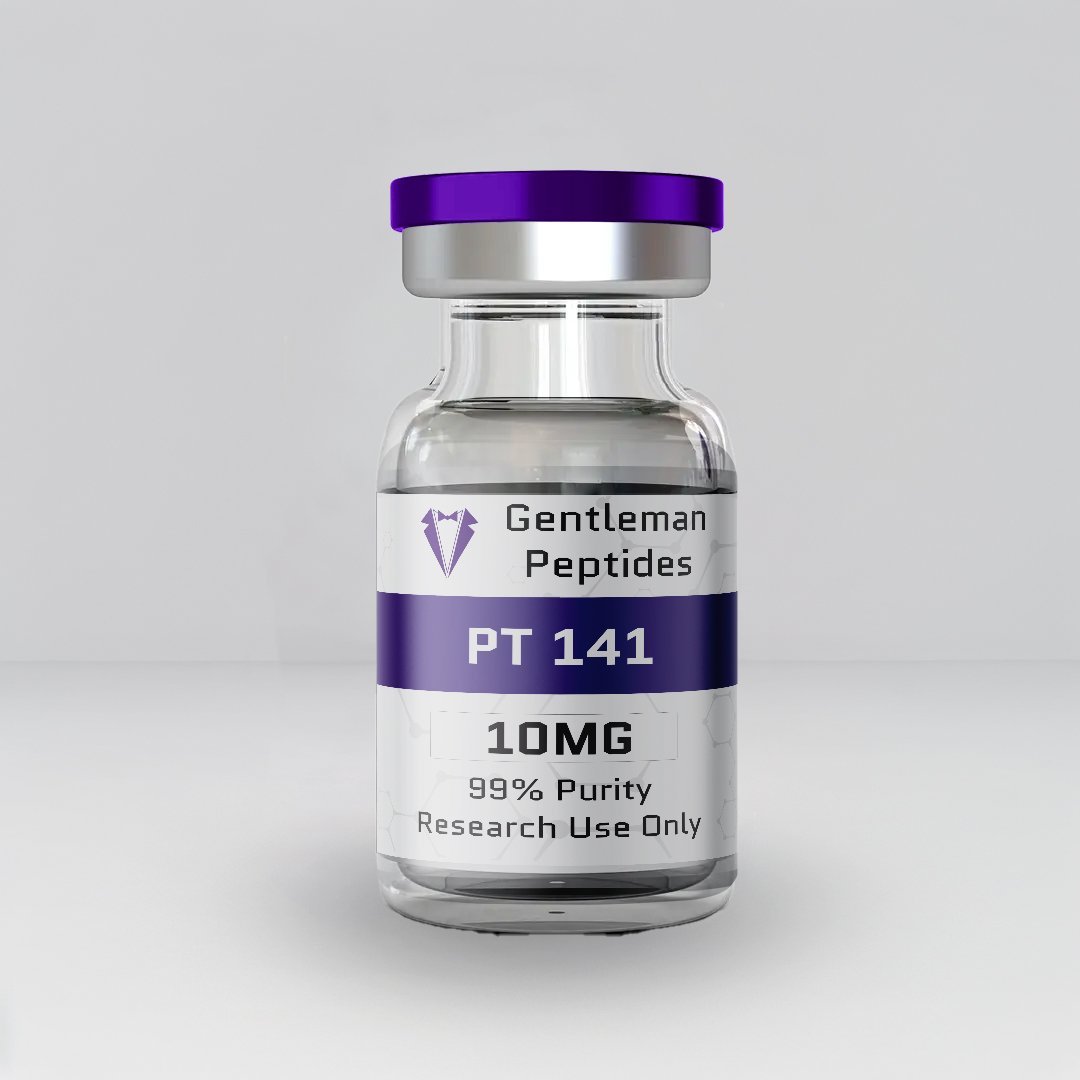
Buy PT-141 Online – PT-141 For Sale at Gentleman Peptides
PT-141, commonly known as Bremelanotide, is a synthetic cyclic peptide analogue related to alpha-melanocyte-stimulating hormone (α-MSH).
It belongs to the melanocortin family of compounds and has been investigated for its interaction with melanocortin receptors, particularly pathways associated with sexual desire and physiological signalling.
Bremelanotide is the active pharmaceutical ingredient in Vyleesi, a prescription medicine approved in the United States for acquired, generalized hypoactive sexual desire disorder (HSDD) in certain premenopausal women.
It is important to distinguish the approved Vyleesi formulation from other products marketed under the PT-141 name. Approval of Vyleesi does not establish the quality, safety, effectiveness or regulatory status of every PT-141 product.
PT-141 Product Specifications
| Specification | Details |
|---|---|
| Product name | PT-141 |
| Scientific name | Bremelanotide |
| Compound classification | Synthetic peptide |
| Peptide type | Cyclic melanocortin analogue |
| Related natural peptide | Alpha-melanocyte-stimulating hormone |
| Pharmacological class | Melanocortin receptor agonist |
| Product category | Vials |
| Product strength | Not stated in the listing |
| Chemical identity | Bremelanotide designation |
| Analytical purity | Not independently verified |
| Regulatory distinction | Approved Vyleesi formulation is prescription-only in the United States |
The competitor listing does not provide a confirmed vial strength or analytical certificate. These details should not be assumed from the product name alone.
Scientific Background of Bremelanotide
Bremelanotide is a synthetic peptide developed from research involving melanocortin signalling.
Melanocortin receptors are part of a biological receptor family involved in several physiological processes.
The receptor family includes:
- MC1R – associated with pigmentation biology
- MC2R – involved in adrenal signalling
- MC3R – associated with metabolic and physiological regulation
- MC4R – involved in appetite and central nervous system signalling
- MC5R – associated with additional physiological processes
Bremelanotide acts as a melanocortin receptor agonist, with activity involving MC1R, MC3R, MC4R and MC5R.
Its pharmacological effects are therefore connected to a broader signalling system rather than a single isolated pathway.
Research Areas Investigated
1. Melanocortin Receptor Signalling
Bremelanotide has been investigated for its interaction with melanocortin receptors.
Research has explored how synthetic melanocortin analogues activate receptor pathways and influence physiological responses.
Its receptor activity provides the scientific foundation for studying its effects beyond pigmentation-related biology.
2. Sexual Desire and Neurobiological Research
One of the major clinical research areas involving bremelanotide concerns hypoactive sexual desire disorder.
Researchers have investigated the relationship between melanocortin signalling and central nervous system pathways involved in sexual desire.
Unlike medicines that primarily act through peripheral blood-flow mechanisms, bremelanotide’s pharmacological activity involves melanocortin receptors.
This distinction is important when comparing it with other medicines used in sexual-health research.
3. Clinical Research and HSDD
Bremelanotide has undergone clinical investigation for acquired, generalized hypoactive sexual desire disorder in premenopausal women.
The FDA approved Vyleesi in 2019 for this specific indication.
The approved indication is limited to women who:
- Are premenopausal
- Have acquired, generalized HSDD
- Experience low sexual desire associated with significant personal distress or interpersonal difficulty
- Do not have the condition primarily because of another medical or psychiatric condition, relationship problems or medication effects
The approved medicine is not indicated for men, postmenopausal women or enhancement of sexual performance.
Clinical evidence for this specific prescription formulation should not be transferred automatically to unapproved PT-141 products.
4. Pharmacological Research
Bremelanotide has also been studied in relation to:
- Melanocortin receptor activation
- Central nervous system signalling
- Receptor selectivity
- Peptide pharmacokinetics
- Physiological responses associated with melanocortin pathways
These areas help researchers understand the compound’s pharmacological properties and potential adverse effects.
Summary of Research Areas
| Research area | Scientific focus |
|---|---|
| MC1R activity | Melanocortin receptor signalling |
| MC3R activity | Broader physiological regulation |
| MC4R activity | Central nervous system pathways |
| Sexual-health research | Clinical investigation of acquired generalized HSDD |
| Pharmacology | Receptor activation and peptide behaviour |
| Clinical development | Bremelanotide prescription formulation |
Approved Medicine Versus Other PT-141 Products
A key distinction is necessary when discussing PT-141.
Vyleesi: An FDA-approved prescription medicine containing bremelanotide in a specific formulation and strength.
Other PT-141-labelled products: Their identity, formulation, manufacturing quality, strength and regulatory status must be evaluated independently.
The FDA approval of Vyleesi does not mean that every product marketed as PT-141 is approved or equivalent to the prescription medicine.
Safety and Regulatory Considerations
Bremelanotide has clinically documented adverse effects and important prescribing restrictions.
According to the FDA-approved Vyleesi prescribing information, safety considerations include:
- Nausea and vomiting
- Facial flushing
- Headache
- Injection-site reactions
- Temporary increases in blood pressure
- Reductions in heart rate
- Focal hyperpigmentation
The prescribing information reports nausea in approximately 40% of patients in the clinical trials.
Vyleesi is contraindicated in patients with uncontrolled hypertension or known cardiovascular disease. It can also affect the absorption of certain oral medicines by slowing gastric emptying.
Other considerations include pregnancy and potential interactions with oral naltrexone.
These safety details apply to the approved prescription medicine and should not be used to establish the safety of an unverified PT-141 vial.
Regulatory Status
Bremelanotide is the active ingredient in Vyleesi, which received FDA approval in 2019.
The approved indication is specific to acquired, generalized HSDD in premenopausal women.
The medicine is not approved for:
- Treatment of HSDD in men
- Treatment of HSDD in postmenopausal women
- General sexual-performance enhancement
Regulatory requirements differ between countries. A product labelled for research use does not automatically establish that it is approved or lawful for human use.
Frequently Asked Questions
What is PT-141?
PT-141 is another name commonly used for Bremelanotide, a synthetic peptide analogue that acts on melanocortin receptors.
Is PT-141 the same as Bremelanotide?
Yes. Bremelanotide is the scientific name of the compound commonly referred to as PT-141.
Is PT-141 a peptide?
Yes. Bremelanotide is a synthetic cyclic peptide.
What is Vyleesi?
Vyleesi is an FDA-approved prescription medicine containing bremelanotide. It is approved for a specific form of hypoactive sexual desire disorder in premenopausal women.
Is PT-141 FDA-approved for men?
No. The approved Vyleesi indication does not include men.
Is PT-141 approved for sexual-performance enhancement?
No. The FDA-approved prescribing information specifically states that Vyleesi is not indicated to enhance sexual performance.
What are the main safety concerns?
Important documented concerns include nausea, flushing, headache, vomiting, temporary increases in blood pressure and reductions in heart rate. The approved medicine is contraindicated in people with uncontrolled hypertension or known cardiovascular disease.
Does every PT-141 vial have the same formulation as Vyleesi?
No. The approved prescription formulation should not be assumed equivalent to other products marketed under the PT-141 name. Product identity, strength, formulation and quality require independent verification.
Scientific References and Further Reading
- U.S. Food and Drug Administration. Vyleesi (bremelanotide injection), Prescribing Information, revised October 2026.
https://www.accessdata.fda.gov/drugsatfda_docs/label/2026/210557s005lbl.pdf - DailyMed. Vyleesi – Bremelanotide Injection, Official Drug Label Information.
https://dailymed.nlm.nih.gov/dailymed/lookup.cfm?setid=f1d0c1b5-2f39-4bad-a6a4-0066e3ad5dcf - U.S. Food and Drug Administration. Drugs@FDA – Vyleesi, NDA 210557.
https://www.accessdata.fda.gov/scripts/cder/daf/ - PubChem. Bremelanotide – Chemical and Molecular Information.
https://pubchem.ncbi.nlm.nih.gov/compound/Bremelanotide
Important Disclaimer
This page is provided for scientific and informational purposes only. It is not medical advice and does not establish any PT-141-labelled product as safe or suitable for human use. Bremelanotide is a prescription pharmaceutical ingredient, and the FDA-approved Vyleesi formulation has a specific indication and important safety restrictions. The strength and analytical quality of the product listing have not been independently verified. Always consider applicable local laws and regulatory requirements.
Be the first to review “PT-141”
Related products

PEPTIDES
PEPTIDES
PEPTIDES
PEPTIDES
PEPTIDES
PEPTIDES

PEPTIDES
PEPTIDES
Reviews
There are no reviews yet.