

BPC157 Capsules – Scientific Overview and Research Information
Overview of BPC157 Capsules
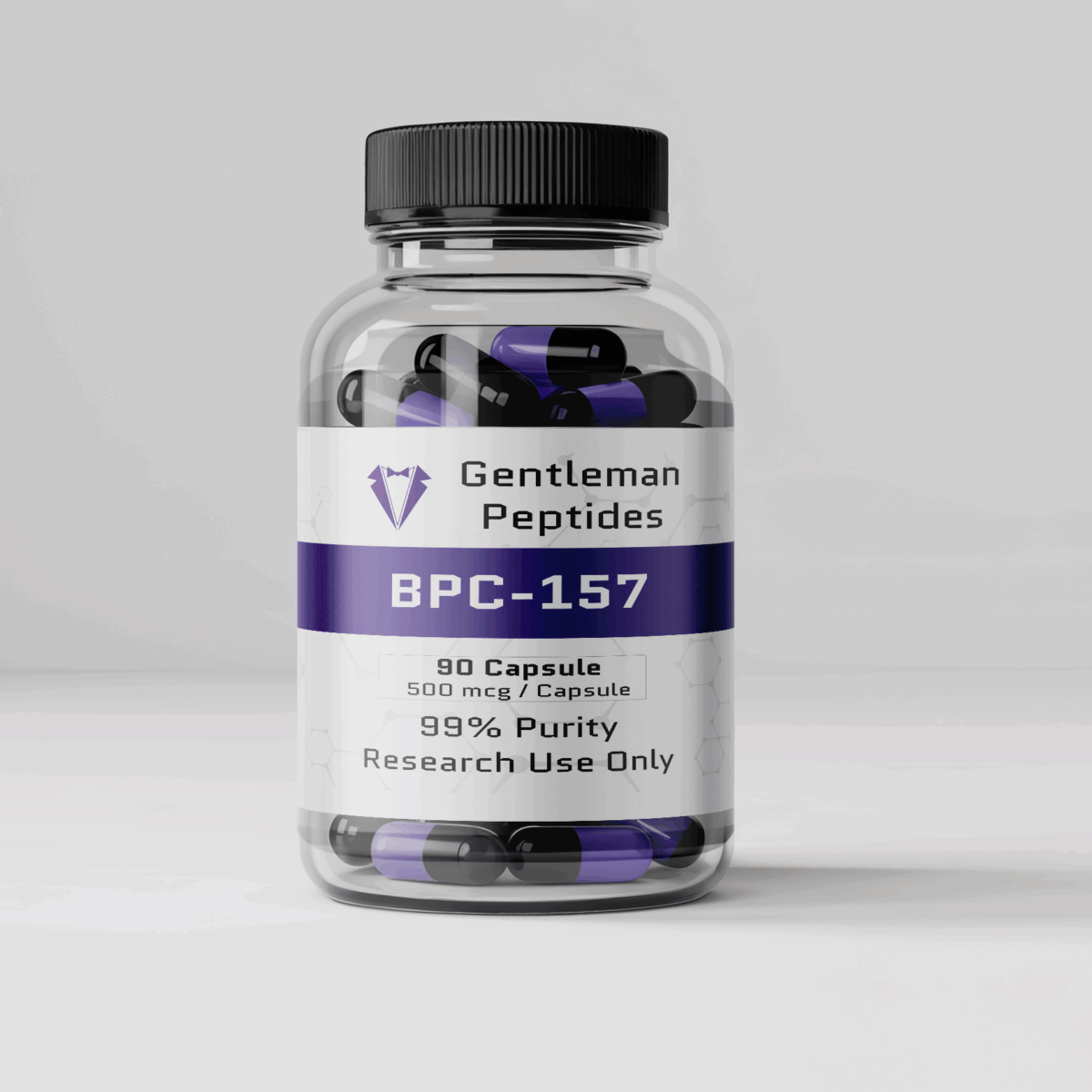
BPC-157, also known as Body Protection Compound-157, is a synthetic peptide consisting of 15 amino acids. It has been investigated in laboratory and animal research involving gastrointestinal biology, cellular signalling, vascular responses and musculoskeletal tissue models.
BPC157 Capsules represent an oral-format presentation of this investigational peptide. Researchers have shown interest in oral administration because of experimental findings involving gastrointestinal models. However, evidence from animal studies cannot establish how a capsule formulation behaves in the human digestive system.
The oral pharmacokinetic profile of BPC-157 in humans remains unknown. There is currently insufficient evidence to establish its absorption, bioavailability, safety or clinical effectiveness when administered as a capsule.
Product Specifications
| Attribute | Details |
|---|---|
| Product name | BPC157 Capsules |
| Active compound | BPC-157 |
| Compound classification | Synthetic peptide |
| Peptide length | 15 amino acids |
| Product category | Capsules |
| Administration format | Oral capsule presentation |
| Quantity per capsule | Not independently confirmed |
| Number of capsules | Not independently confirmed |
| Chemical form | Requires manufacturer confirmation |
| Analytical documentation | Not independently verified |
Specification note: The active ingredient quantity per capsule and total capsule count should be confirmed from the actual product label or manufacturer documentation before publication.
Scientific Background of BPC-157
BPC-157 has been investigated for its possible biological activity across several experimental systems.
Its research history includes studies involving gastrointestinal tissue, cellular responses, vascular biology and connective-tissue models.
Although preclinical studies have reported biological activity, the precise molecular mechanisms remain incompletely understood. The available research does not establish BPC-157 as an approved medicine.
Oral BPC-157 Research
1. Gastrointestinal Stability
One reason researchers have investigated oral BPC-157 is its reported stability in gastric juice under experimental conditions.
This observation has generated interest in studying the peptide in gastrointestinal models.
However, stability in gastric juice alone does not prove that an orally administered peptide will be absorbed intact or reach the bloodstream in meaningful quantities.
2. Oral Bioavailability
Bioavailability describes the proportion of an administered compound that reaches systemic circulation in an active form.
For oral peptides, several factors can influence bioavailability, including:
- Breakdown by digestive enzymes.
- Stability within the gastrointestinal environment.
- Passage through the intestinal lining.
- Chemical formulation and excipients.
- Metabolism before reaching systemic circulation.
For BPC-157, these processes have not been adequately characterized in humans following oral capsule administration.
Consequently, oral absorption and systemic exposure should be treated as unresolved research questions.
3. Gastrointestinal Experimental Models
Animal research has investigated BPC-157 in experimental models involving gastric and intestinal biology.
These studies have examined different biological responses associated with gastrointestinal tissue and cellular processes.
The findings provide a basis for further scientific investigation, but they do not establish clinical effectiveness in humans.
4. Cellular Signalling and Tissue Research
Other preclinical studies have examined BPC-157 in cellular signalling, vascular responses and musculoskeletal tissue models.
These areas contribute to the broader scientific interest in the peptide, although the findings should not be interpreted as proof of therapeutic effects.
Research Findings and Scientific Areas of Interest
Gastrointestinal Biology
Experimental studies have investigated BPC-157 in gastrointestinal models, including research involving gastric and intestinal tissue responses.
These findings remain predominantly preclinical and do not demonstrate that oral capsules treat gastrointestinal conditions.
Peptide Stability and Formulation
Formulation research is important because peptide molecules can be affected by environmental conditions, digestive enzymes and manufacturing processes.
For oral BPC-157 products, further investigation is needed into formulation stability, intestinal permeability, absorption and pharmacokinetics.
Cellular and Vascular Research
Laboratory and animal studies have explored possible interactions involving cellular signalling and vascular processes.
The precise molecular targets and mechanisms remain incompletely established.
Summary of Research Areas
| Research area | Scientific focus | Evidence status |
|---|---|---|
| Gastric stability | Peptide stability in gastric environments | Experimental |
| Oral absorption | Intestinal permeability and systemic exposure | Insufficient human data |
| Gastrointestinal biology | Experimental gastric and intestinal models | Primarily preclinical |
| Cellular signalling | Proposed biological pathways | Under investigation |
| Vascular biology | Experimental vascular responses | Primarily preclinical |
| Human pharmacokinetics | Absorption and distribution following oral administration | Not established |
Evidence Limitations and Scientific Considerations
BPC-157 remains an investigational peptide with important gaps in its clinical and pharmaceutical development.
The FDA’s July 2026 briefing document reported that it had not identified human pharmacokinetic studies following oral BPC-157 administration. It also concluded that available clinical safety information was insufficient to characterize the safety profile of BPC-157 free base and BPC-157 acetate.
A 2026 review in Pharmaceutics also highlighted unresolved issues involving oral formulation development, intestinal permeability, pharmacokinetics and the limited nature of available human research.
Important limitations include:
- Human oral absorption has not been established.
- Human oral pharmacokinetic data are lacking.
- There is insufficient evidence to establish oral clinical effectiveness.
- Long-term safety remains inadequately characterized.
- Different chemical forms and formulations may not have identical properties.
- Product labels alone cannot confirm identity, purity or quality.
BPC-157 Capsules should therefore be discussed as an investigational oral-format product, not as an established therapeutic formulation.
Frequently Asked Questions
What are BPC157 Capsules?
BPC157 Capsules are an oral-format presentation of BPC-157, a synthetic 15-amino-acid peptide investigated in preclinical scientific research.
Is BPC-157 a peptide?
Yes. BPC-157 is a synthetic peptide made up of 15 amino acids.
Has oral BPC-157 been studied?
Oral administration has been investigated in animal research. However, human oral pharmacokinetic data remain unavailable, and the absorption of commercial capsule formulations in humans has not been established.
Does BPC-157 survive stomach acid?
Experimental research has reported stability in gastric juice. However, this does not establish that an oral capsule is absorbed intact or produces a measurable systemic effect in humans.
Is BPC-157 FDA-approved?
No. BPC-157 is not an FDA-approved drug. Its regulatory status and restrictions should be checked in the relevant jurisdiction.
How much BPC-157 is contained in each capsule?
The amount per capsule has not been independently confirmed for this listing. It should be verified using the manufacturer’s label and product documentation.
Are BPC-157 Capsules proven to be effective?
No. Available research is insufficient to establish clinical effectiveness or safety in humans.
Scientific References
- U.S. Food and Drug Administration. (2026). July 23–24, 2026 Pharmacy Compounding Advisory Committee Meeting: BPC-157-Related Bulk Drug Substances.
https://www.fda.gov/media/193773/download - BPC-157 as an Investigational Peptide Therapeutic: Biopharmaceutical Challenges, Formulation Strategies, and Translational Development Barriers. Pharmaceutics. 2026;18(5):625.
https://doi.org/10.3390/pharmaceutics18050625 - Compound Evidence Institute. (2025; reviewed 2026). Human Evidence for BPC-157.
https://www.compoundedevidence.com/syntheses/bpc-157-human-evidence/
Important Research Disclaimer
The information on this page is provided for scientific and educational reference. BPC-157 is an investigational compound and is not an FDA-approved medicine. Available evidence does not establish its safety or effectiveness for human or veterinary use.
Product identity, quantity, formulation and analytical quality should be supported by appropriate manufacturer documentation. Regulatory requirements vary by jurisdiction. This page does not provide medical advice or instructions for human administration.
Be the first to review “BPC – 157 CAPSULES”
Related products

PEPTIDES

PEPTIDES
PEPTIDES
PEPTIDES
PEPTIDES
PEPTIDES
PEPTIDES
PEPTIDES
Reviews
There are no reviews yet.