

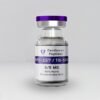

AOD 9604 – Scientific Overview and Research Information
What Is AOD9604?
AOD9604 is a synthetic peptide developed from a modified fragment of human growth hormone (hGH). It is based on a region near the C-terminal end of the growth hormone molecule, commonly associated with amino-acid residues 176–191.
Unlike full-length human growth hormone, AOD9604 is a much shorter peptide consisting of 16 amino acids.
It was originally investigated as a potential obesity-related research compound. Early research focused on whether the modified growth hormone fragment could influence fat metabolism without reproducing all the biological effects associated with full-length growth hormone.
AOD9604 has been studied in biochemical experiments, animal models and human clinical investigations.
However, the proposed metabolic effects have not translated into established clinical effectiveness for weight management.
Product Specifications
| Specification | Details |
|---|---|
| Product Name | AOD9604 |
| Alternative Names | AOD-9604, Modified hGH Fragment |
| Compound Type | Synthetic peptide |
| Peptide Length | 16 amino acids |
| Structural Origin | Modified C-terminal region of human growth hormone |
| Original Research Focus | Fat metabolism and obesity |
| Research Areas | Lipid metabolism and metabolic regulation |
| Product Category | Vials, according to the competitor listing |
| Listed Strength | Not specified |
| Supplied Form | Requires product-specific confirmation |
The precise molecular identity, sequence, salt form, quantity and composition should be confirmed against the actual product specification. A vial label or product listing alone does not establish peptide identity or purity.
Understanding the Growth Hormone Fragment
Human growth hormone is a protein hormone produced by the anterior pituitary gland. It participates in growth, metabolism and the regulation of several physiological processes.
AOD9604 was developed by modifying a short region of the growth hormone molecule.
1. The C-Terminal Region
The C-terminal region refers to the end portion of a protein or peptide sequence.
AOD9604 is based on a modified fragment associated with residues 176–191 of human growth hormone.
This region attracted research interest because of experimental observations involving lipid metabolism.
2. Structural Modification
AOD9604 is not identical to the corresponding natural growth hormone sequence.
It is a modified 16-amino-acid peptide developed for experimental investigation.
The distinction is important because the biological properties of a peptide fragment cannot automatically be assumed to match those of the complete parent hormone.
3. Proposed Metabolic Activity
Early research investigated whether AOD9604 could influence processes associated with fat metabolism.
Researchers examined experimental measurements involving lipid breakdown, fat accumulation and metabolic activity.
However, the exact molecular target and mechanism responsible for its reported effects remain insufficiently established.
The FDA’s 2024 evaluation specifically identified uncertainty surrounding the mechanism underlying AOD9604’s pharmacological effects.
What Does Research Show About AOD9604?
Research involving AOD9604 developed through laboratory investigations, animal experiments and clinical studies.
The compound initially attracted interest because of experimental findings involving fat metabolism.
However, the available human evidence requires careful interpretation, particularly because its major obesity-development programme did not establish a significant weight-loss advantage over placebo.
1. Early Research into Lipid Metabolism
Early experimental research investigated whether a modified fragment of human growth hormone could influence lipid metabolism.
Researchers examined changes in fat-related biological measurements in experimental systems.
These investigations provided the scientific background for developing AOD9604 as a potential obesity-related compound.
The research was based on the hypothesis that selected regions of growth hormone might have metabolic effects that could be investigated separately from the actions of the complete hormone.
Research significance: Early experiments established the rationale for further investigating growth hormone fragments in lipid metabolism.
2. Research in Animal Models
AOD9604 was examined in animal models involving obesity and metabolic processes.
Researchers investigated changes in body-weight measurements, fat-related outcomes and other metabolic indicators.
Some early animal experiments reported changes in weight gain and fat-related measurements.
These results contributed to the decision to investigate the compound in human clinical studies.
However, animal findings cannot establish that the same effects will occur in people.
Research significance: Animal studies provided preliminary experimental observations, but they did not establish human weight-loss effectiveness.
3. Human Clinical Research into Obesity
AOD9604 progressed into human clinical development as a potential obesity-related treatment.
Its development programme included randomized, placebo-controlled clinical studies.
One major Phase IIb investigation examined oral AOD9604 in adults with obesity.
The study’s primary objective was to determine whether the compound could produce a meaningful improvement in body-weight measurements compared with placebo.
According to the FDA’s December 2024 evaluation, the available clinical information did not establish a significant weight-loss advantage over placebo at the primary endpoint.
The development programme for obesity was subsequently discontinued.
Research significance: The human clinical findings did not establish AOD9604 as an effective obesity treatment.
4. Research into Growth Hormone and IGF-1 Measurements
Researchers also examined whether AOD9604 influenced growth hormone-related measurements, including insulin-like growth factor 1 (IGF-1).
IGF-1 is a growth factor associated with growth hormone signalling and several metabolic processes.
The available clinical safety literature reported no significant effect on IGF-1 in the studied programme.
This was relevant because researchers wanted to understand whether a modified growth hormone fragment behaved differently from full-length growth hormone.
However, the absence of a significant IGF-1 change does not demonstrate that a compound is safe or effective for weight management.
Research significance: Hormonal measurements helped characterize the experimental compound but did not establish a clinical benefit.
5. Research into Safety and Tolerability
Human clinical investigations included assessments of adverse events and tolerability.
A 2013 publication by Stier and colleagues summarized safety information from six clinical studies involving AOD9604.
The publication examined adverse events and selected laboratory measurements from the development programme.
However, a report focusing on safety and tolerability should not be interpreted as proof of weight-loss effectiveness.
The FDA’s later evaluation identified important limitations in the available clinical safety information, particularly concerning long-term use and routes of administration that were not adequately studied in humans.
Research significance: Safety observations from earlier clinical studies provide background information, but they do not establish a comprehensive or validated safety profile.
6. FDA Evaluation of AOD9604
In December 2024, the US Food and Drug Administration presented an evaluation of AOD9604 and AOD9604 acetate to its Pharmacy Compounding Advisory Committee.
The review considered the available clinical and nonclinical evidence.
The FDA identified several important uncertainties, including:
- Limited information concerning the mechanism of action.
- Insufficient evidence to establish effectiveness for obesity.
- Limited information about long-term human safety.
- Lack of human information for proposed subcutaneous and transdermal routes.
- Potential immunogenicity associated with the peptide.
- Nonclinical safety signals involving bone health, possible liver toxicity and genotoxicity.
The FDA also noted that serious adverse events reported in the available human information included diarrhea, chest tightness and various types of cancers. These reports do not by themselves establish that AOD9604 caused each event, but they are relevant to the safety assessment.
Research significance: The FDA evaluation highlights substantial evidence gaps and safety uncertainties that should not be overlooked when describing AOD9604.
Summary of Research Areas
| Research Area | Scientific Focus | Evidence Type |
|---|---|---|
| Peptide Structure | Modified growth hormone fragment | Biochemical research |
| Lipid Metabolism | Investigation of fat-related biological processes | Laboratory research |
| Metabolic Regulation | Evaluation of metabolic measurements | Animal research |
| Body Weight | Investigation of obesity-related outcomes | Human clinical research |
| IGF-1 | Evaluation of growth-factor measurements | Human clinical research |
| Safety and Tolerability | Adverse-event and laboratory assessments | Human clinical research |
| Regulatory Evaluation | Review of clinical and nonclinical evidence | FDA assessment |
Evidence Limitations and Scientific Considerations
AOD9604 has undergone several stages of scientific investigation, but important limitations remain.
Clinical effectiveness is not established: The major obesity-development programme did not establish a significant weight-loss advantage over placebo at its primary endpoint.
Not an approved obesity medicine: AOD9604 should not be represented as an approved weight-management treatment.
Uncertain mechanism: The exact molecular target and mechanism responsible for its proposed metabolic activity remain incompletely understood.
Animal findings do not establish human benefits: Experimental observations in animals cannot be used as proof of weight-loss effectiveness in people.
Route-specific evidence is limited: The FDA did not identify adequate human information for proposed subcutaneous and transdermal use.
Long-term safety remains uncertain: Available clinical information is insufficient to establish long-term safety for repeated use.
Potential immunogenicity: As a 16-amino-acid peptide, AOD9604 may have the potential to trigger an immune response.
Product quality requires verification: Identity, peptide sequence, purity, concentration and batch composition should be established through appropriate analytical documentation.
Overall, AOD9604 is best understood as an investigational modified growth hormone fragment that was studied for potential metabolic applications but did not establish clinical effectiveness for obesity.
Frequently Asked Questions
What is AOD9604?
AOD9604 is a synthetic 16-amino-acid peptide fragment developed from a modified region of human growth hormone.
Is AOD9604 a peptide?
Yes. AOD9604 is a synthetic peptide consisting of 16 amino acids.
What is the relationship between AOD9604 and human growth hormone?
AOD9604 was developed from a modified fragment of the C-terminal region of human growth hormone. It is not equivalent to full-length growth hormone.
What has AOD9604 been studied for?
Research has investigated AOD9604 in lipid metabolism, metabolic regulation and obesity-related experimental models.
Has AOD9604 been studied in humans?
Yes. AOD9604 progressed through human clinical investigations, including studies examining its potential application in obesity.
Did clinical research establish weight-loss effectiveness?
The available FDA evaluation reports that the major obesity study did not establish a significant weight-loss advantage over placebo at its primary endpoint.
Is AOD9604 an approved medicine?
AOD9604 is not an FDA-approved obesity medicine. Its investigational history should not be confused with pharmaceutical approval.
What does the 9604 designation mean?
AOD9604 is the development designation used for this modified growth hormone fragment.
What are the main scientific limitations?
Important limitations include uncertain mechanism of action, insufficient evidence of clinical effectiveness, limited long-term safety information and uncertainty concerning different routes of administration.
Scientific References
- US Food and Drug Administration. (2024). AOD-9604 and AOD-9604 Acetate: Pharmacy Compounding Advisory Committee Evaluation.
December 4, 2024.
https://www.fda.gov/media/183584/download - US Food and Drug Administration. (2024). Pharmacy Compounding Advisory Committee Meeting Materials: AOD-9604.
https://www.fda.gov/media/183891/download - Stier H, Vos E, Kenley R. (2013). Safety and tolerability of AOD9604, a novel modified fragment of human growth hormone.
The publication summarizes safety and tolerability information from clinical investigations. It should not be interpreted as evidence of established weight-loss effectiveness.
Important Research Disclaimer
AOD9604 is an investigational peptide and is not an FDA-approved medicine for weight management or any other therapeutic indication.
The scientific information presented is for educational and research-reference purposes only. It does not establish human clinical effectiveness, an appropriate method of administration or a validated long-term safety profile.
The information should not be interpreted as a recommendation for human or animal consumption, self-administration, diagnosis, treatment, cure or prevention of any disease.
Product identity, peptide sequence, concentration, purity and batch-related claims should be supported by appropriate analytical documentation. Applicable laws and regulatory requirements should be reviewed before any product is offered or supplied.
Be the first to review “AOD 9604”
Related products
PEPTIDES

PEPTIDES
PEPTIDES
PEPTIDES

PEPTIDES
PEPTIDES
PEPTIDES

PEPTIDES
Reviews
There are no reviews yet.