
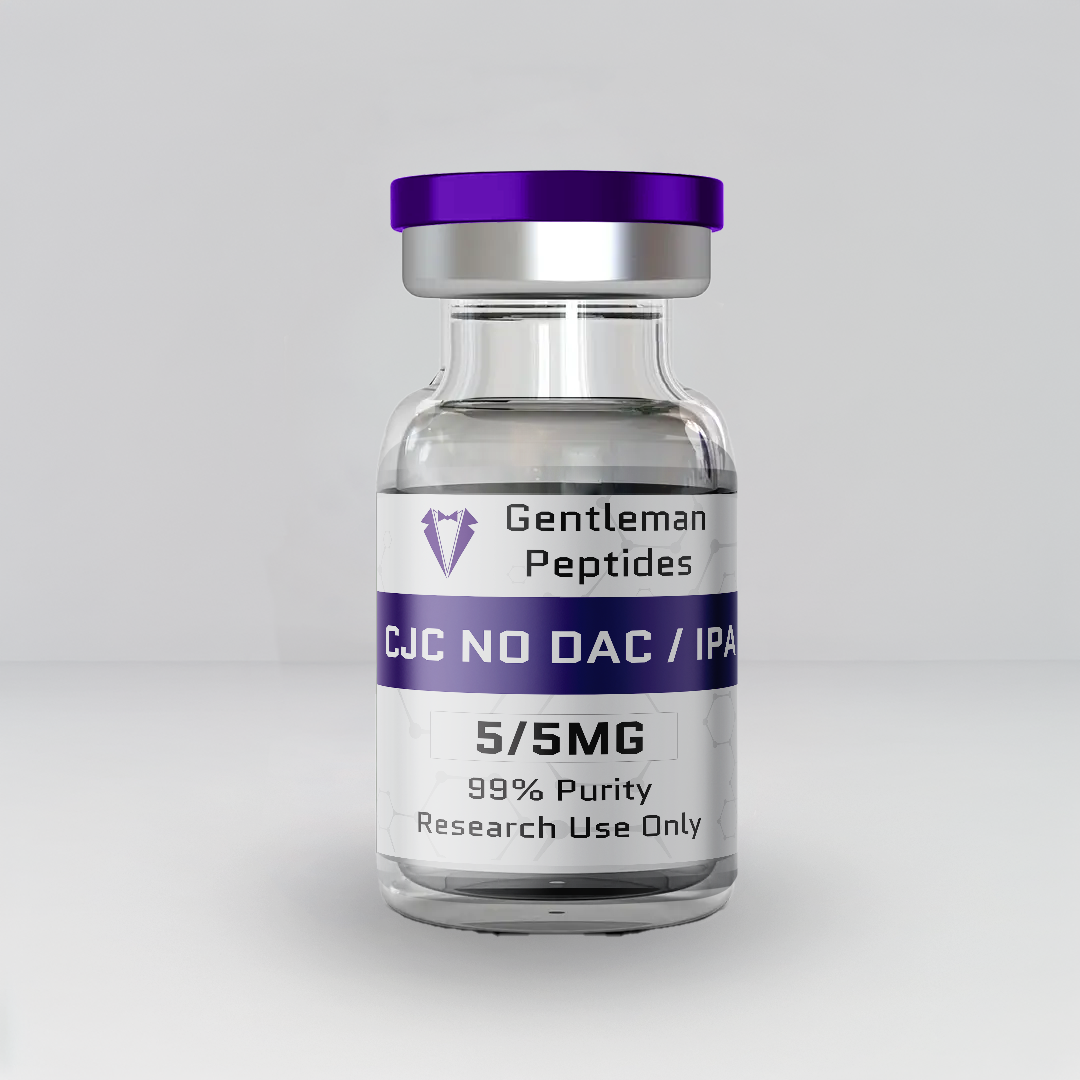

CJC / Ipamorelin – Scientific Overview and Research Information
Overview of CJC / Ipamorelin
CJC / Ipamorelin is a combination of two synthetic peptides that have attracted scientific interest because of their interaction with the body’s growth-hormone signalling system.
The combination contains two distinct compounds:
- CJC-1295: A synthetic analogue of growth hormone-releasing hormone (GHRH), investigated for its interaction with GHRH receptors.
- Ipamorelin: A synthetic pentapeptide that acts as a growth hormone secretagogue through the ghrelin receptor, also known as GHS-R1a.
Although both compounds have been investigated individually, they act through different receptor pathways.
The combination has been discussed in experimental and pharmacological contexts, but published human clinical evidence establishing the safety or effectiveness of the two compounds together remains insufficient.
Product Specifications
| Attribute | Details |
|---|---|
| Product name | CJC / Ipamorelin |
| Components | CJC-1295 and Ipamorelin |
| Compound classification | Synthetic peptides |
| CJC-1295 classification | GHRH analogue |
| Ipamorelin classification | Growth hormone secretagogue |
| Product category | Vial |
| Individual component quantities | Not independently confirmed |
| Blend ratio | Not confirmed |
| CJC-1295 form | DAC or non-DAC status requires confirmation |
| Chemical form and salt information | Requires manufacturer confirmation |
| Batch-specific analytical testing | Not independently verified |
Specification note: The individual quantities of CJC-1295 and ipamorelin should be confirmed from the product label or manufacturer documentation. The two components should not be assumed to be present in equal amounts.
Scientific Background of CJC-1295
CJC-1295 is a synthetic analogue of growth hormone-releasing hormone.
GHRH is a naturally occurring hormone involved in regulating growth-hormone secretion from the anterior pituitary gland.
CJC-1295 has been investigated for its ability to interact with this signalling pathway.
CJC-1295 and GHRH Receptor Activity
GHRH binds to receptors in the pituitary gland and participates in the regulation of growth-hormone secretion.
CJC-1295 was developed to mimic aspects of this signalling process.
Research involving CJC-1295 has examined growth-hormone and insulin-like growth factor 1 (IGF-1) measurements.
DAC and Non-DAC Forms
An important distinction in CJC-1295 research concerns its formulation.
CJC-1295 with DAC: DAC stands for Drug Affinity Complex. This modification allows the peptide to bind to albumin in circulation, extending its duration of activity.
CJC-1295 without DAC: Often associated with the name Modified GRF 1-29, this is a different formulation with different pharmacological characteristics.
Research findings involving the DAC form should not automatically be attributed to non-DAC formulations.
The exact CJC-1295 form in this product listing has not been confirmed.
Scientific Background of Ipamorelin
Ipamorelin is a synthetic pentapeptide, meaning it consists of five amino acids.
It belongs to the growth hormone secretagogue group and has been investigated for its interaction with the ghrelin receptor, also known as GHS-R1a.
Ghrelin Receptor Signalling
The ghrelin receptor participates in several physiological processes, including regulation of growth-hormone secretion.
Ipamorelin acts as an agonist at this receptor.
Experimental research has examined its pharmacological activity and effects on growth-hormone secretion.
Selectivity Research
Ipamorelin was investigated partly because of its receptor activity and selectivity in experimental models.
However, findings from individual experimental studies do not establish its long-term safety or effectiveness in humans.
How the Two Peptides Differ
CJC-1295 and ipamorelin interact with different signalling pathways.
| Characteristic | CJC-1295 | Ipamorelin |
|---|---|---|
| Peptide type | Synthetic GHRH analogue | Synthetic pentapeptide |
| Main receptor pathway | GHRH receptor | Ghrelin receptor (GHS-R1a) |
| Primary research focus | Growth-hormone signalling | Growth-hormone secretagogue activity |
| DAC modification | Available in certain forms | Not applicable |
| Human research | Limited studies, mainly DAC form | Limited clinical research |
| Combination evidence | No established clinical evidence for the blend | No established clinical evidence for the blend |
The fact that two compounds act on different pathways does not establish that combining them produces additional clinical benefits.
Research Findings and Scientific Areas of Interest
1. Growth-Hormone Signalling
CJC-1295 has been investigated for its effects on growth-hormone secretion.
Human studies involving the DAC-modified form reported changes in circulating growth-hormone and IGF-1 measurements.
These studies examined hormonal responses rather than establishing improvements in general health, physical performance or body composition.
2. Ipamorelin Pharmacological Research
Ipamorelin has been investigated in animal models and limited human clinical research.
Research has examined its interaction with ghrelin receptors and its relationship with growth-hormone secretion.
A clinical study involving intravenous ipamorelin in patients recovering from bowel surgery reported serious safety events. The FDA has highlighted these findings in its safety assessment.
3. Growth-Hormone and IGF-1 Measurements
Both compounds have been investigated in relation to the growth-hormone system.
Growth hormone can influence the production of IGF-1, a hormone involved in several biological processes.
However, changes in hormone measurements do not automatically establish a beneficial clinical outcome.
4. Combination Research
The combination of CJC-1295 and ipamorelin is often discussed because the compounds act through different receptor pathways.
However, evidence involving each compound individually cannot be treated as evidence for the combined formulation.
There is insufficient published human clinical evidence to establish the pharmacokinetics, safety or effectiveness of the combination itself.
Summary of Scientific Research
| Research area | Scientific focus | Evidence status |
|---|---|---|
| GHRH receptor activity | CJC-1295 interaction with GHRH signalling | Investigated |
| Ghrelin receptor activity | Ipamorelin interaction with GHS-R1a | Investigated |
| Growth-hormone measurements | Hormonal responses to individual compounds | Limited human evidence |
| IGF-1 measurements | Changes associated with CJC-1295 DAC research | Limited human evidence |
| Combination pharmacology | Interaction between both peptides | Insufficient evidence |
| Long-term safety | Extended exposure and potential adverse effects | Not established |
| Finished-product quality | Identity, ratio and peptide impurities | Requires product-specific verification |
Evidence Limitations and Scientific Considerations
CJC-1295 and ipamorelin remain investigational compounds with important evidence gaps.
The United States Food and Drug Administration has identified safety concerns associated with both substances.
CJC-1295 Safety Considerations
The FDA has reported serious adverse events associated with CJC-1295, including increased heart rate and systemic vasodilatory reactions.
It has also identified concerns involving peptide-related impurities, aggregation, immunogenicity and incomplete characterization of different CJC-1295 forms.
Ipamorelin Safety Considerations
The FDA has identified potential immunogenicity concerns involving ipamorelin acetate.
The agency has also highlighted a published study reporting serious adverse events, including death, when ipamorelin was administered intravenously in a clinical investigation involving gastric motility.
These findings do not establish the risk of every possible formulation or route, but they are important safety considerations.
Combination Evidence Gaps
Additional uncertainties arise when the compounds are combined:
- The individual component quantities may differ between formulations.
- The CJC-1295 DAC status may not be clearly identified.
- The pharmacokinetics of the combined formulation are not established.
- The long-term safety of the combination is unknown.
- Product-specific purity and impurity profiles require verification.
- Evidence from separate studies cannot establish the safety or effectiveness of the combined product.
CJC / Ipamorelin should therefore be described as an investigational peptide combination rather than an established therapeutic formulation.
Regulatory and Sporting Considerations
Neither CJC-1295 nor ipamorelin is an FDA-approved medicine.
The FDA has identified significant safety and characterization concerns in its assessments of these compounds for pharmaceutical compounding.
Both compounds are also relevant to anti-doping regulations. Athletes should consult the applicable World Anti-Doping Agency Prohibited List and their sporting authority.
Regulatory requirements differ between countries.
Frequently Asked Questions
What is CJC / Ipamorelin?
It is a combination of two synthetic peptides: CJC-1295 and ipamorelin. They have been investigated for their interactions with different growth-hormone signalling pathways.
What is the difference between CJC-1295 and ipamorelin?
CJC-1295 is a synthetic GHRH analogue, while ipamorelin is a pentapeptide that acts on the ghrelin receptor.
What does DAC mean in CJC-1295?
DAC means Drug Affinity Complex. It is a modification that enables CJC-1295 to bind to albumin, affecting its duration of activity.
Is CJC-1295 the same as Modified GRF 1-29?
The names are commonly associated with different formulations. Modified GRF 1-29 is generally used to describe the non-DAC form, whereas CJC-1295 with DAC has an additional albumin-binding modification.
Have CJC-1295 and ipamorelin been tested together in human clinical trials?
There is insufficient published human clinical evidence establishing the safety or effectiveness of the two compounds in combination.
Are CJC-1295 and ipamorelin FDA-approved?
No. Neither compound is an FDA-approved medicine.
Does the product name establish the blend ratio?
No. The name identifies the two listed components but does not establish their individual quantities or ratio. Manufacturer documentation is needed to confirm those specifications.
Are these compounds classified as peptides?
Yes. Both CJC-1295 and ipamorelin are synthetic peptides.
Scientific References
- U.S. Food and Drug Administration. (2026). Certain Bulk Drug Substances for Use in Compounding that May Present Significant Safety Risks.
https://www.fda.gov/drugs/human-drug-compounding/certain-bulk-drug-substances-use-compounding-may-present-significant-safety-risks - U.S. Food and Drug Administration. (2024). December 4, 2024 Pharmacy Compounding Advisory Committee Meeting: CJC-1295.
https://www.fda.gov/media/183819/download - U.S. Food and Drug Administration. (2024). October 29, 2024 Pharmacy Compounding Advisory Committee Meeting: Ipamorelin.
https://www.fda.gov/media/183017/download - Teichman SL, Neale A, Lawrence B, et al. (2006). Prolonged stimulation of growth hormone and insulin-like growth factor I secretion by CJC-1295, a long-acting analog of growth hormone-releasing hormone, in healthy adults. Journal of Clinical Endocrinology & Metabolism.
- Raun K, Hansen BS, Johansen NL, et al. (1998). Ipamorelin, the first selective growth hormone secretagogue. European Journal of Endocrinology.
Important Research Disclaimer
CJC-1295 and ipamorelin are investigational synthetic peptides and are not FDA-approved medicines. Available evidence does not establish the safety or effectiveness of their combined use in humans.
The information on this page is provided for scientific and educational reference. It does not constitute medical advice or establish suitability for human or veterinary use.
Product identity, individual component quantities, formulation, blend ratio and analytical quality should be supported by appropriate manufacturer documentation. Regulatory requirements vary by jurisdiction.
Be the first to review “CJC / Ipamorelin”
Related products
PEPTIDES
PEPTIDES
PEPTIDES

PEPTIDES
PEPTIDES

PEPTIDES

PEPTIDES

PEPTIDES
Reviews
There are no reviews yet.