
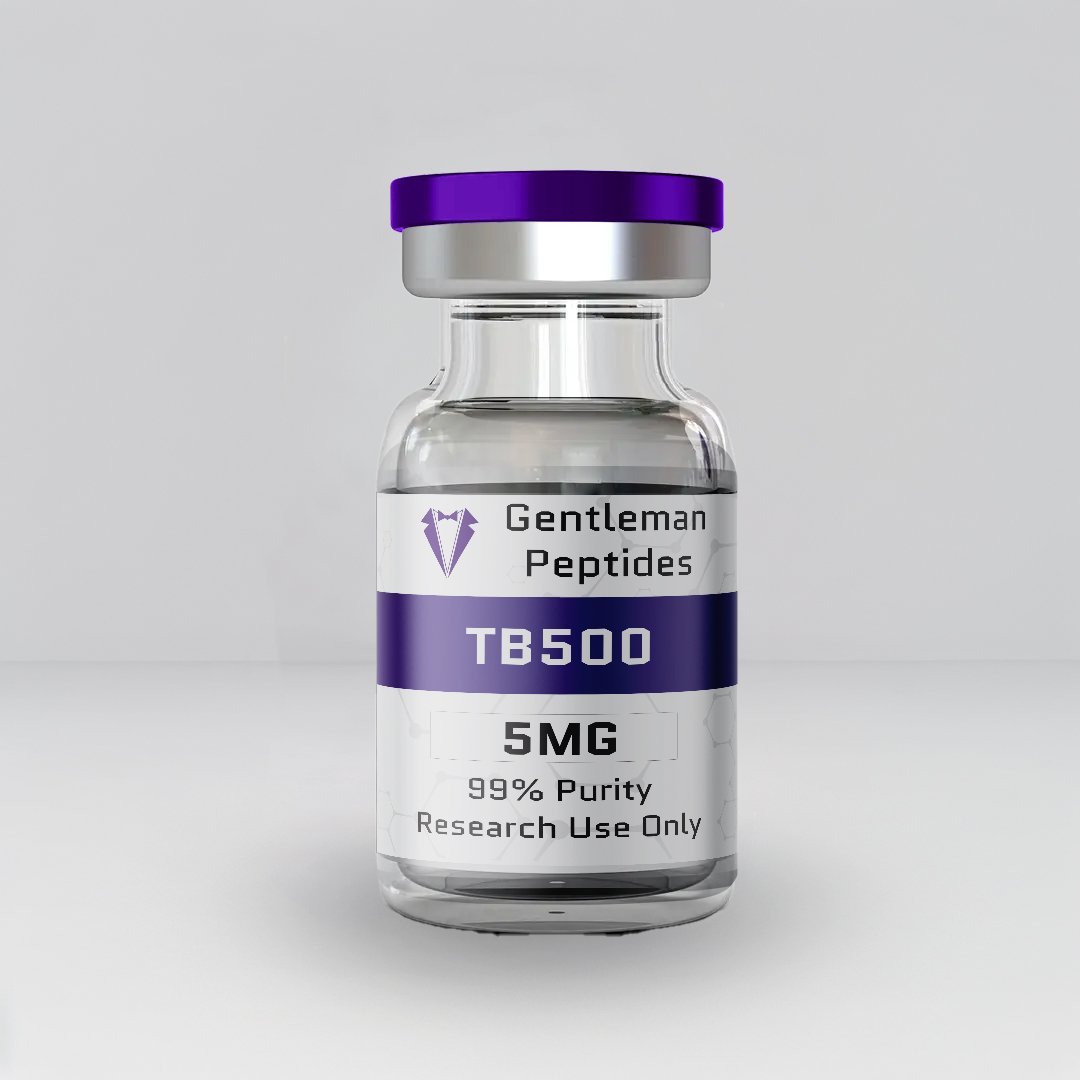
Buy TB-500 5mg Online – TB-500 5mg For Sale at Gentleman Peptides
TB-500 5MG is listed as a synthetic peptide research compound associated with thymosin beta-4 (Tβ4).
Thymosin beta-4 is a naturally occurring 43-amino-acid peptide involved in several cellular processes, including actin regulation, cell migration and tissue-related biological signalling.
TB-500 is commonly described as a synthetic, N-acetylated seven-amino-acid fragment of thymosin beta-4. Its commonly reported sequence is:
Ac-Leu-Lys-Lys-Thr-Glu-Thr-Gln-OH
An important scientific distinction exists between TB-500 and full-length thymosin beta-4. They are related molecules, but they are not interchangeable. Research findings involving the complete 43-amino-acid peptide cannot automatically be attributed to the shorter TB-500 fragment.
Product Specifications
| Attribute | Details |
|---|---|
| Product name | TB-500 5MG |
| Common scientific designation | TB-500 |
| Related protein | Thymosin beta-4 |
| Product category | Vials |
| Listed strength | 5MG |
| Compound classification | Synthetic peptide fragment |
| Peptide length | 7 amino acids |
| Commonly reported sequence | Ac-LKKTETQ |
| Research area | Actin-related cellular processes |
| Chemical form | Not independently confirmed |
| Purity and testing | Documentation not provided |
Chemical identity note: TB-500 is commonly associated with the N-acetylated fragment Ac-LKKTETQ. The exact chemical form and identity of this particular product listing have not been independently established.
Scientific Background of TB-500
Thymosin beta-4 is a small, naturally occurring peptide found in many types of human and animal cells.
One of its important biological roles involves binding to actin, a protein that contributes to the internal structure and movement of cells.
Actin regulation is relevant to several cellular processes, including:
- Cell migration
- Cytoskeletal organisation
- Cellular movement
- Tissue-related signalling
- Interactions involved in experimental repair models
TB-500 is associated with a short region of thymosin beta-4 containing part of its actin-binding sequence.
However, a short peptide fragment does not necessarily reproduce all the biological properties of the complete protein.
Proposed Biological Research Pathways
1. Actin-Related Cellular Processes
Actin is an important component of the cytoskeleton, the internal framework that helps cells maintain their shape and move.
Thymosin beta-4 has been extensively studied for its relationship with actin regulation. The TB-500 fragment contains a sequence associated with the actin-binding region.
The presence of this sequence does not, by itself, establish that the fragment reproduces the full biological activity of thymosin beta-4.
2. Cell Migration Research
Cell migration is involved in numerous biological processes, including embryonic development, immune responses and experimental tissue-repair models.
Researchers investigate thymosin beta-4-related pathways to understand how cellular movement is regulated.
Direct evidence for the commonly marketed TB-500 fragment remains limited.
3. Fibroblast Research
Fibroblasts are connective-tissue cells involved in extracellular matrix production and tissue structure.
Laboratory research has investigated thymosin beta-4-related compounds in fibroblast models. However, findings from the complete protein should not be presented as established effects of TB-500.
4. Tissue-Related Signalling
Research involving full-length thymosin beta-4 has explored cellular migration, inflammatory signalling, angiogenesis and extracellular matrix processes.
These pathways provide scientific context for studying related peptide fragments, but they do not establish clinical benefits for TB-500.
Research Areas Involving TB-500 and Thymosin Beta-4
Actin and Cytoskeletal Research
Researchers examine how thymosin beta-4-related molecules interact with actin and how this interaction relates to cellular structure and movement.
Cellular Migration
Experimental research investigates the movement of different cell types and the signalling processes associated with migration.
Fibroblast and Extracellular Matrix Research
Studies involving thymosin beta-4 have explored fibroblast activity and extracellular matrix-related processes. Evidence should be attributed to the specific molecule studied.
Angiogenesis Research
Angiogenesis refers to the formation of new blood vessels. Full-length thymosin beta-4 has been studied in experimental models involving vascular and endothelial-cell processes.
These findings cannot be assumed to establish the same activity for the TB-500 fragment.
Musculoskeletal Research
TB-500 is frequently discussed in connection with tendon, ligament and muscle research. However, direct clinical evidence supporting musculoskeletal treatment with the marketed TB-500 fragment is lacking.
Clinical Evidence and Research Limitations
The evidence surrounding TB-500 requires particular care because the name is often used inconsistently.
Research involving full-length thymosin beta-4 is considerably broader than research involving the short TB-500 fragment.
A 2026 scoping review of thymosin beta-4 and TB-500 found that most available literature concerned full-length thymosin beta-4, while direct evidence involving TB-500 was very limited.
A separate 2026 review in the Journal of the American Academy of Orthopaedic Surgeons highlighted the distinction between the full-length protein and the TB-500 fragment. It also noted the absence of controlled human orthopaedic efficacy evidence.
Important evidence limitations include:
- Limited direct research on the TB-500 fragment.
- No established controlled human musculoskeletal efficacy trials for the fragment.
- Uncertainty about whether commercial products contain the stated molecular form.
- Insufficient long-term human safety information.
- Limited evidence supporting the transfer of full-length thymosin beta-4 findings to TB-500.
Therefore, claims that TB-500 is clinically proven for injury recovery, tissue regeneration or musculoskeletal treatment are not supported by the current evidence.
Summary of Research Areas
| Research area | Scientific focus |
|---|---|
| Actin regulation | Cytoskeletal organisation |
| Cell migration | Cellular movement and signalling |
| Fibroblast research | Connective-tissue cell biology |
| Extracellular matrix | Cellular and structural interactions |
| Angiogenesis | Experimental vascular signalling |
| Musculoskeletal research | Limited direct fragment evidence |
| Molecular research | TB-500 and thymosin beta-4 differences |
Safety and Regulatory Considerations
TB-500 is not an FDA-approved medicine for musculoskeletal treatment.
In July 2026, the FDA published a Pharmacy Compounding Advisory Committee briefing concerning TB-500. The agency identified significant evidence limitations, including a lack of adequate human exposure and safety information for the fragment.
Important considerations include:
- Limited human safety data.
- Uncertainty surrounding the identity and composition of commercial products.
- Potential peptide aggregation and degradation.
- Concerns involving peptide impurities and manufacturing consistency.
- Lack of established clinical dosing and long-term safety information.
The World Anti-Doping Agency’s 2026 Prohibited List includes thymosin beta-4 and its derivatives, including TB-500.
A research-use designation does not establish that a product is approved, lawful or suitable for human or veterinary use.
Frequently Asked Questions
What is TB-500 5MG?
TB-500 5MG is a product listing identified as a synthetic peptide related to thymosin beta-4. TB-500 is commonly described as an acetylated seven-amino-acid fragment.
Is TB-500 the same as thymosin beta-4?
No. Thymosin beta-4 is a naturally occurring 43-amino-acid peptide, while TB-500 is commonly identified as a shorter seven-amino-acid synthetic fragment.
What is the commonly reported TB-500 sequence?
The commonly reported sequence is Ac-Leu-Lys-Lys-Thr-Glu-Thr-Gln, abbreviated Ac-LKKTETQ.
What is TB-500 studied for?
Research interest includes actin-related cellular processes, cell migration and pathways associated with thymosin beta-4 biology. Direct research on the commonly marketed fragment remains limited.
Is TB-500 clinically proven for tendon or muscle injuries?
No. There is no established controlled human clinical evidence demonstrating that the marketed TB-500 fragment is an effective treatment for tendon, ligament or muscle injuries.
Is TB-500 FDA-approved?
No. TB-500 does not have FDA approval as a medicine for musculoskeletal treatment.
Is TB-500 included on the WADA Prohibited List?
Yes. The 2026 WADA Prohibited List includes thymosin beta-4 and its derivatives, including TB-500.
Is the listed product independently verified?
The product listing does not provide sufficient independent documentation to confirm its exact chemical identity, purity, sterility or batch quality.
Scientific References
- Tham A, Hodgkins CW, Kennedy JG. Investigational Peptides in Orthopaedic Practice: Evidence, Safety, and Patient Counseling for BPC-157, Thymosin Beta-4, and TB-500. Journal of the American Academy of Orthopaedic Surgeons. 2026. DOI: 10.5435/JAAOS-D-26-00049.
- McGuire F, Hughes E, Maak T, Cushman DM. Thymosin Beta-4 and TB-500 in Tissue Healing, Regeneration, and Musculoskeletal Repair: A Scoping Review. Applied Sciences. 2026;16(12):6202. DOI: 10.3390/app16126202.
- U.S. Food and Drug Administration. July 23–24, 2026 Pharmacy Compounding Advisory Committee briefing: TB-500 (Thymosin Beta-4 Fragment).
- World Anti-Doping Agency. 2026 Prohibited List. Section S2: Peptide Hormones, Growth Factors, Related Substances and Mimetics.
Important Disclaimer
This content is provided for scientific and educational information. TB-500 is investigational and is not an approved treatment for human or veterinary conditions.
This page does not provide medical advice, treatment recommendations or administration instructions. Findings involving full-length thymosin beta-4 should not be interpreted as proof of the effectiveness or safety of TB-500.
Product identity, chemical form, purity and quality must be established through appropriate independent documentation and analytical testing.
Be the first to review “TB-500 5mg”
Related products
PEPTIDES
PEPTIDES

PEPTIDES

PEPTIDES

PEPTIDES
PEPTIDES
PEPTIDES
PEPTIDES
Reviews
There are no reviews yet.