
Buy KLOW Online – KLOW For Sale at Gentleman Peptides
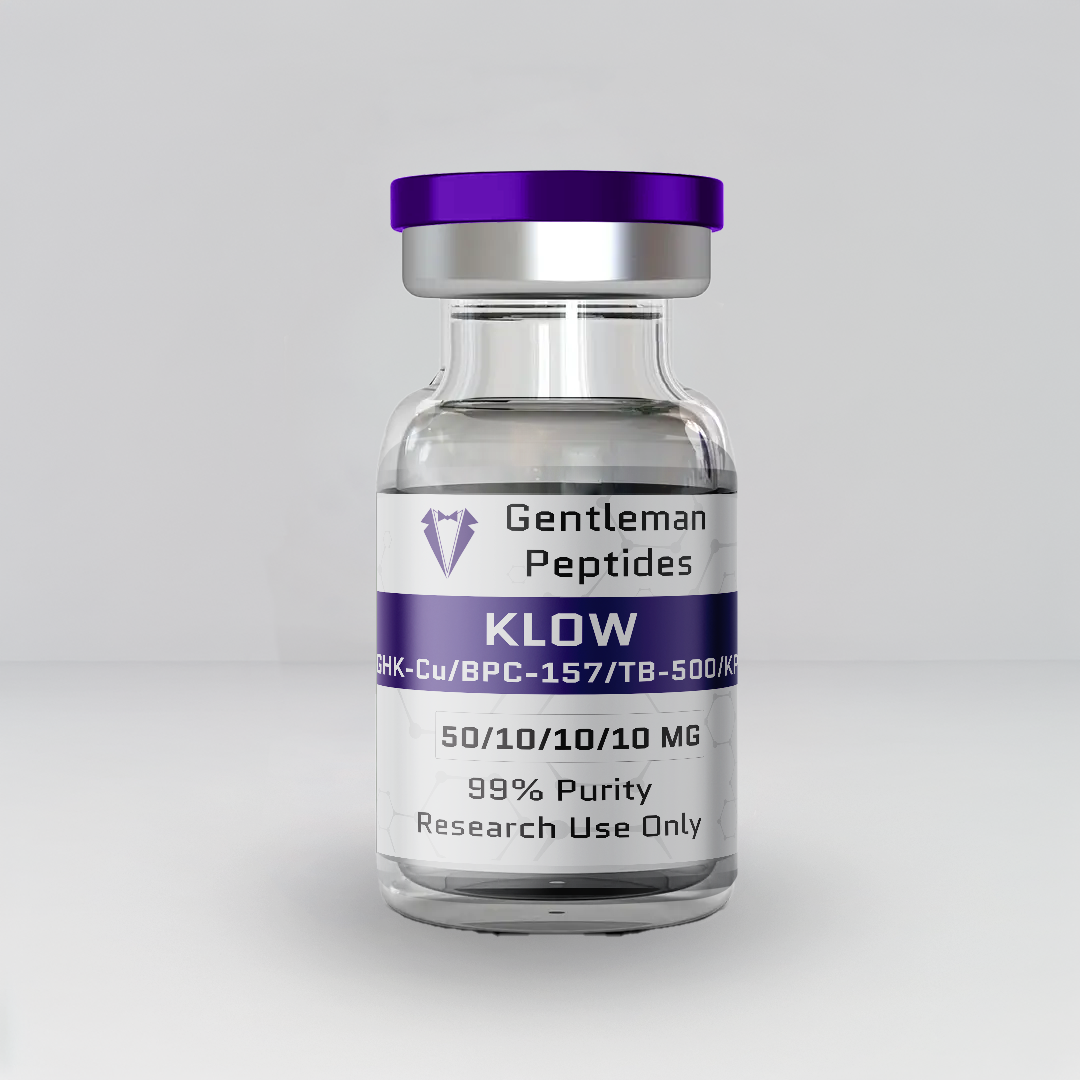
KLOW is a multi-component peptide formulation labelled as containing four compounds: GHK-Cu, BPC-157, TB-500 and KPV. Each ingredient has a separate research history and a different molecular structure.
The label supplied for this product lists a 50MG / 10MG / 10MG / 10MG composition. These quantities are presented as label-declared information rather than independently confirmed analytical results.
KLOW is a product name for a combination formulation, not a single molecule with one established chemical identity. Research findings concerning any individual ingredient should not be interpreted as proof of the safety, effectiveness, stability or combined activity of the finished formulation.
KLOW Product Specifications
| Specification | Label information |
|---|---|
| Product name | KLOW |
| Product category | Peptide blend |
| Form | Vial |
| GHK-Cu | 50MG |
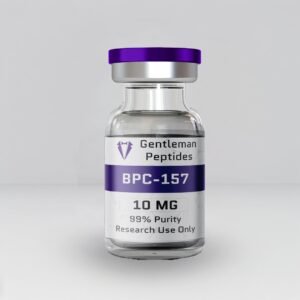
| BPC-157 | 10MG |
| TB-500 | 10MG |
| KPV | 10MG |
| Total stated component quantity | 80MG |
| Label purity statement | 99% (not independently verified) |
| Product identifier | KLOW |
| Formulation details | Not independently confirmed |
Important: The quantities above reflect the supplied product label. They do not establish the identity, purity, concentration, sterility or analytical quality of the material. The exact chemical form of each ingredient and the analytical documentation should be confirmed independently.
Scientific Background of the Four Components
1. GHK-Cu – 50MG
GHK-Cu, also known as copper tripeptide-1, is a copper complex of the naturally occurring tripeptide glycyl-L-histidyl-L-lysine (GHK).
It has been investigated in laboratory research involving:
- Fibroblast and extracellular-matrix biology
- Collagen-related cellular pathways
- Copper-dependent biological processes
- Oxidative-stress signalling
- Cellular responses involved in tissue biology
Research on GHK-Cu includes laboratory studies and investigations of topical formulations. Findings from topical or cell-based research cannot automatically be applied to other formulations or routes of exposure.
The FDA has identified potential immunogenicity concerns associated with injectable GHK-Cu, including issues involving aggregation and peptide-related impurities. Human safety information remains limited.
2. BPC-157 – 10MG
BPC-157 is a synthetic peptide consisting of 15 amino acids. Its sequence is commonly reported as:
GEPPPGKPADDAGLV
It has been investigated primarily in preclinical models involving gastrointestinal biology, cellular signalling and musculoskeletal research.
Areas explored in laboratory and animal studies include:
- Gastrointestinal tissue models
- Tendon and ligament research
- Cellular signalling pathways
- Vascular and endothelial biology
- Inflammatory-response pathways
Much of the published research is preclinical. The available evidence does not establish BPC-157 as an effective treatment for human medical conditions.
The FDA has also identified concerns involving possible immunogenicity, peptide-related impurities and insufficient human safety information for proposed routes of administration.
3. TB-500 – 10MG
TB-500 is a name commonly used for a synthetic fragment associated with thymosin beta-4 research. The fragment commonly identified as TB-500 is the seven-amino-acid sequence LKKTETQ.
Thymosin beta-4 is a naturally occurring protein involved in actin-related cellular processes. Research involving thymosin beta-4 has explored:
- Actin regulation
- Cell migration
- Cellular organisation
- Tissue and wound biology
- Cell-response pathways
An important scientific distinction is that TB-500 should not automatically be treated as identical to full-length thymosin beta-4. Research involving the complete protein cannot simply be transferred to the shorter fragment.
The FDA has identified potential immunogenicity concerns, aggregation and peptide-related impurity issues for TB-500, alongside a lack of adequate human exposure and safety information.
4. KPV – 10MG
KPV is a synthetic tripeptide consisting of three amino acids:
Lysine – Proline – Valine (Lys-Pro-Val)
It corresponds to amino-acid positions 11–13 of alpha-melanocyte-stimulating hormone (α-MSH).
KPV has been investigated in nonclinical research involving:
- Inflammatory signalling
- Nuclear factor-kappa B (NF-κB) pathways
- Cytokine-related cellular responses
- Gastrointestinal inflammatory models
- Peptide transport and cellular biology
Laboratory and animal findings have explored possible anti-inflammatory properties. However, the molecular targets and relevance of these findings to human medicine remain uncertain.
The FDA’s review noted a lack of identified human exposure data for KPV-containing drug products and insufficient information to determine its safety in humans.
Research Areas Associated With the Ingredients
The four ingredients have been studied in different research contexts. The following table summarises the broad areas investigated without suggesting that the combined formulation has demonstrated these effects.
| Component | Research area | Evidence context |
|---|---|---|
| GHK-Cu | Copper-peptide and extracellular-matrix biology | Laboratory and topical research |
| BPC-157 | Gastrointestinal and musculoskeletal models | Predominantly preclinical |
| TB-500 | Actin-related cellular processes | Research involving TB-500 and thymosin beta-4 must be distinguished |
| KPV | Inflammatory signalling and cytokine pathways | Primarily laboratory and animal research |
Does Research Establish a Combined KLOW Effect?
No established scientific conclusion can be drawn about the combined effects of this exact four-component formulation from research on its individual ingredients.
The fact that GHK-Cu, BPC-157, TB-500 and KPV have each been studied separately does not demonstrate that combining them produces an additive or synergistic effect.
Important unanswered research questions include:
- Whether the four ingredients remain chemically stable when combined
- Whether the components are compatible in the same formulation
- Whether one ingredient affects the stability or behaviour of another
- Whether the stated composition can be analytically confirmed
- Whether the finished blend has an adequately characterised safety profile
There is not sufficient established clinical evidence to describe KLOW as a proven treatment or to claim that the combination produces a particular medical outcome.
Evidence Limitations
The scientific literature on these compounds is uneven. Much of the available work involves isolated compounds, laboratory models or animal studies rather than controlled human clinical trials.
Evidence from one ingredient cannot be treated as evidence for the complete four-component formulation.
There are also important formulation questions. The label’s stated quantities do not independently establish the exact molecular forms, purity, stability, sterility or concentration of the finished material.
Safety and Regulatory Considerations
KLOW should not be presented as an approved medicine or as an established treatment for any medical condition.
The FDA has identified safety-related information gaps for several of its listed components, including BPC-157, injectable GHK-Cu, TB-500 and KPV. These include concerns about immunogenicity, aggregation, peptide-related impurities and inadequate human safety information.
Regulatory requirements differ between countries. A product label stating “Research Use Only” does not itself establish that a product is lawful, safe or suitable for human use.
No human administration, dosage or treatment recommendations are provided here.
Frequently Asked Questions
What is KLOW?
KLOW is a product name used for a multi-component peptide blend. The supplied label identifies GHK-Cu, BPC-157, TB-500 and KPV.
What are the stated ingredients in this KLOW formulation?
The label lists GHK-Cu 50MG, BPC-157 10MG, TB-500 10MG and KPV 10MG.
What is the total stated quantity?
The four listed quantities add up to 80MG. This is the sum of the label-declared component amounts, not an independently verified analytical measurement.
Is KLOW a single peptide?
No. KLOW is a name for a combination formulation containing multiple compounds. It does not have one single molecular structure.
Has the complete KLOW blend been clinically established?
The available evidence does not establish the safety or effectiveness of this exact four-component blend in humans. Research on its individual ingredients is not proof of the combined formulation’s properties.
Is KLOW FDA-approved?
KLOW is not an FDA-approved medicine. Regulatory status and requirements may differ in other jurisdictions.
Does the label’s 99% purity statement confirm product quality?
No. A printed purity statement is not a substitute for independently verifiable analytical documentation. Appropriate testing would need to identify and quantify the relevant components and assess the finished formulation.
Scientific References and Further Reading
- U.S. Food and Drug Administration – Certain Bulk Drug Substances for Use in Compounding that May Present Significant Safety Risks.
https://www.fda.gov/drugs/human-drug-compounding/certain-bulk-drug-substances-use-compounding-may-present-significant-safety-risks - U.S. Food and Drug Administration – July 23–24, 2026 Pharmacy Compounding Advisory Committee meeting materials.
https://www.fda.gov/media/193773/download - Raun K. et al. Research literature on the pharmacological properties of peptide compounds should be assessed according to the specific compound and experimental model studied.
Important Disclaimer
This page is provided for general scientific and informational purposes. It is not medical advice and does not establish the safety, efficacy or suitability of KLOW for human or veterinary use. The stated product composition is based on the supplied label and has not been independently verified. Research findings for individual ingredients should not be interpreted as evidence that the combined formulation has demonstrated clinical benefits. Always consider applicable local laws and regulatory requirements.
Be the first to review “KLOW”
Related products
PEPTIDES
PEPTIDES
PEPTIDES
PEPTIDES
PEPTIDES

PEPTIDES
PEPTIDES

PEPTIDES
Reviews
There are no reviews yet.