


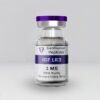
Buy Ipamorelin Online – Ipamorelin For Sale at Gentleman Peptides
Product Overview
Ipamorelin 5MG is a labelled presentation of ipamorelin, a synthetic peptide belonging to the growth-hormone secretagogue family.
Ipamorelin has been investigated for its ability to stimulate growth-hormone release through activation of the ghrelin receptor, also known as growth hormone secretagogue receptor type 1a (GHS-R1a).
Unlike growth hormone-releasing hormone (GHRH) analogues, which act through a different receptor system, ipamorelin activates the ghrelin receptor pathway.
Scientific investigations have examined its endocrine activity, receptor selectivity and potential gastrointestinal effects.
Ipamorelin remains an investigational compound. Its safety and effectiveness have not been established for general human use.
Product Specifications
| Specification | Information |
|---|---|
| Product name | Ipamorelin 5MG |
| Compound classification | Synthetic pentapeptide |
| Peptide length | 5 amino acids |
| Main receptor | GHS-R1a |
| Research classification | Growth-hormone secretagogue |
| Labelled amount | 5MG |
| Product format | Vial |
| Salt form | Not confirmed |
| Purity | Not independently verified |
| Batch testing | Documentation not supplied |
What Is Ipamorelin?
Ipamorelin is a synthetic peptide developed as a growth-hormone secretagogue.
Growth-hormone secretagogues are compounds investigated for their ability to stimulate the release of growth hormone from the pituitary gland.
Ipamorelin is structurally classified as a pentapeptide because it consists of five amino-acid residues.
Its molecular structure includes modified amino-acid components that contribute to its receptor activity and distinguish it from naturally occurring peptide hormones.
The compound has been studied in laboratory research and early-stage human investigations.
Mechanism of Action
Ipamorelin acts primarily as an agonist of the growth hormone secretagogue receptor type 1a (GHS-R1a), commonly known as the ghrelin receptor.
This receptor is involved in endocrine signalling and is expressed in several tissues, including the pituitary and hypothalamus.
1. Ghrelin Receptor Activation
GHS-R1a is the receptor through which ghrelin and certain synthetic secretagogues produce biological effects.
Activation of this receptor is associated with signalling pathways involved in growth-hormone secretion.
Ipamorelin has been investigated because of its relatively selective activity within this receptor system.
2. Growth Hormone Signalling
Growth hormone is produced by somatotroph cells in the anterior pituitary gland.
Research has examined how ipamorelin-related receptor activation influences growth-hormone release.
Growth hormone participates in several physiological processes, including metabolism, growth regulation and interactions with insulin-like growth factor 1 (IGF-1).
However, stimulation of growth-hormone release in an experimental setting does not establish a clinical benefit.
3. Selectivity of Hormonal Activity
One of the scientific interests surrounding ipamorelin is its reported selectivity compared with some earlier growth-hormone secretagogues.
Early studies investigated its endocrine effects and found a growth-hormone response without comparable changes in several other pituitary-adrenal hormones under the conditions studied.
These findings are specific to the experimental settings and do not establish long-term safety.
Scientific Research Areas
1. Growth Hormone Secretion
Ipamorelin has been studied for its ability to stimulate growth-hormone release through GHS-R1a activation.
Early pharmacological investigations examined dose-related growth-hormone responses in experimental models and human research.
This research has contributed to understanding the ghrelin receptor system and its relationship with pituitary hormone secretion.
2. Ghrelin Receptor Biology
The ghrelin receptor is involved in several biological processes beyond growth-hormone signalling.
Research involving this receptor has examined its relationship with appetite regulation, gastrointestinal activity and endocrine communication.
Ipamorelin provides a synthetic compound for investigating aspects of this receptor system.
3. Gastrointestinal Motility Research
Ipamorelin has also been investigated for possible effects on gastrointestinal motility.
A randomized, controlled proof-of-concept clinical trial examined intravenous ipamorelin in patients recovering from bowel resection surgery.
The study included 114 patients in its safety and modified intention-to-treat populations.
Although the trial examined postoperative gastrointestinal recovery, it did not demonstrate a statistically significant improvement in its main efficacy endpoint compared with placebo.
This distinction is important when interpreting the clinical evidence.
4. Endocrine Pharmacology
Ipamorelin has been studied in the broader field of endocrine pharmacology, particularly in relation to synthetic secretagogues and the regulation of pituitary hormone release.
Research in this area helps explain how receptor-selective compounds interact with the body’s hormonal signalling systems.
Summary of Research Areas
| Research area | Scientific focus |
|---|---|
| Growth-hormone secretion | Regulation of pituitary GH release |
| Ghrelin receptor biology | GHS-R1a activation |
| Endocrine pharmacology | Hormonal signalling and receptor selectivity |
| Gastrointestinal research | Experimental gastrointestinal motility |
| Clinical pharmacology | Human safety and efficacy investigations |
Clinical Evidence and Research Limitations
Ipamorelin has been investigated in early human studies, but its clinical evidence remains limited.
A randomized phase 2 proof-of-concept study examined its use in postoperative ileus following bowel resection.
The study did not demonstrate a statistically significant improvement in its primary efficacy endpoint compared with placebo.
The FDA has also reviewed ipamorelin acetate and ipamorelin free base in the context of proposed pharmaceutical compounding.
The agency identified concerns involving:
- Potential peptide aggregation.
- Peptide-related impurities.
- Immunogenicity.
- Challenges in chemical characterization.
- Insufficient safety information for certain proposed routes of administration.
- Limited evidence supporting the proposed clinical uses.
The FDA also discussed serious adverse events, including deaths, reported in a study involving intravenous ipamorelin. The relationship between those events and ipamorelin was not established.
These limitations mean that laboratory activity should not be interpreted as proof of clinical safety or effectiveness.
Safety and Regulatory Considerations
Ipamorelin is not an FDA-approved medicine.
Its safety and effectiveness for general human use have not been established through an approved clinical development programme.
Potential safety concerns identified in FDA reviews include immunogenicity, aggregation, impurities and insufficient information about certain routes of exposure.
The FDA’s October 2024 briefing also discussed reported hypokalaemia and hyperglycaemia in clinical information reviewed by the agency.
Ipamorelin should not be presented as an established treatment for growth-hormone deficiency, muscle development, fat loss or recovery.
The World Anti-Doping Agency also includes growth-hormone secretagogues and their mimetics within its prohibited categories.
Frequently Asked Questions
What is Ipamorelin 5MG?
Ipamorelin 5MG is a labelled presentation of a synthetic five-amino-acid peptide investigated for its activity as a ghrelin receptor agonist and growth-hormone secretagogue.
What receptor does ipamorelin activate?
Ipamorelin acts primarily on growth hormone secretagogue receptor type 1a (GHS-R1a), also known as the ghrelin receptor.
Is ipamorelin a GHRH analogue?
No. Ipamorelin is a ghrelin receptor agonist. GHRH analogues act through the growth hormone-releasing hormone receptor, which is a different receptor system.
Has ipamorelin been studied in humans?
Yes. Early human studies have examined its pharmacological activity and potential clinical applications, including a randomized study involving postoperative ileus.
Is ipamorelin FDA-approved?
No. Ipamorelin is not an FDA-approved medicine.
What is the difference between ipamorelin and CJC-1295?
Ipamorelin activates the ghrelin receptor, GHS-R1a. CJC-1295 is a synthetic analogue of growth hormone-releasing hormone and acts through a different receptor system.
Is ipamorelin the same as growth hormone?
No. Ipamorelin is a synthetic peptide investigated for its ability to stimulate endogenous growth-hormone release. It is not growth hormone itself.
What does 5MG represent?
The 5MG designation refers to the amount stated in the product name. Independent verification of the actual contents requires appropriate product and batch documentation.
Scientific References
- Raun K, et al. Ipamorelin, the first selective growth hormone secretagogue. European Journal of Endocrinology. 1998;139(5):552–561. Foundational pharmacological research on ipamorelin.
- Beck DE, et al. Prospective, randomized, controlled, proof-of-concept study of the ghrelin mimetic ipamorelin for the management of postoperative ileus in bowel resection patients. International Journal of Colorectal Disease. 2014;29:1527–1534. DOI: 10.1007/s00384-014-2030-8.
- US Food and Drug Administration. October 29, 2024 Pharmacy Compounding Advisory Committee – Evaluation of Ipamorelin-Related Bulk Drug Substances.
- US Food and Drug Administration. Certain Bulk Drug Substances for Use in Compounding That May Present Significant Safety Risks. Ipamorelin acetate safety information.
Important Research Disclaimer
This page is provided for general scientific and educational information only.
Ipamorelin is an investigational peptide and is not an FDA-approved medicine. Its safety and effectiveness for human use have not been established.
The 5MG designation is based on the product name and does not independently verify the actual contents, purity, sterility, chemical identity or batch quality.
This description is not medical advice and does not provide instructions or recommendations for human administration.
Be the first to review “Ipamorelin 5mg”
Related products
PEPTIDES
PEPTIDES
PEPTIDES
PEPTIDES

PEPTIDES
PEPTIDES

PEPTIDES

PEPTIDES
Reviews
There are no reviews yet.