
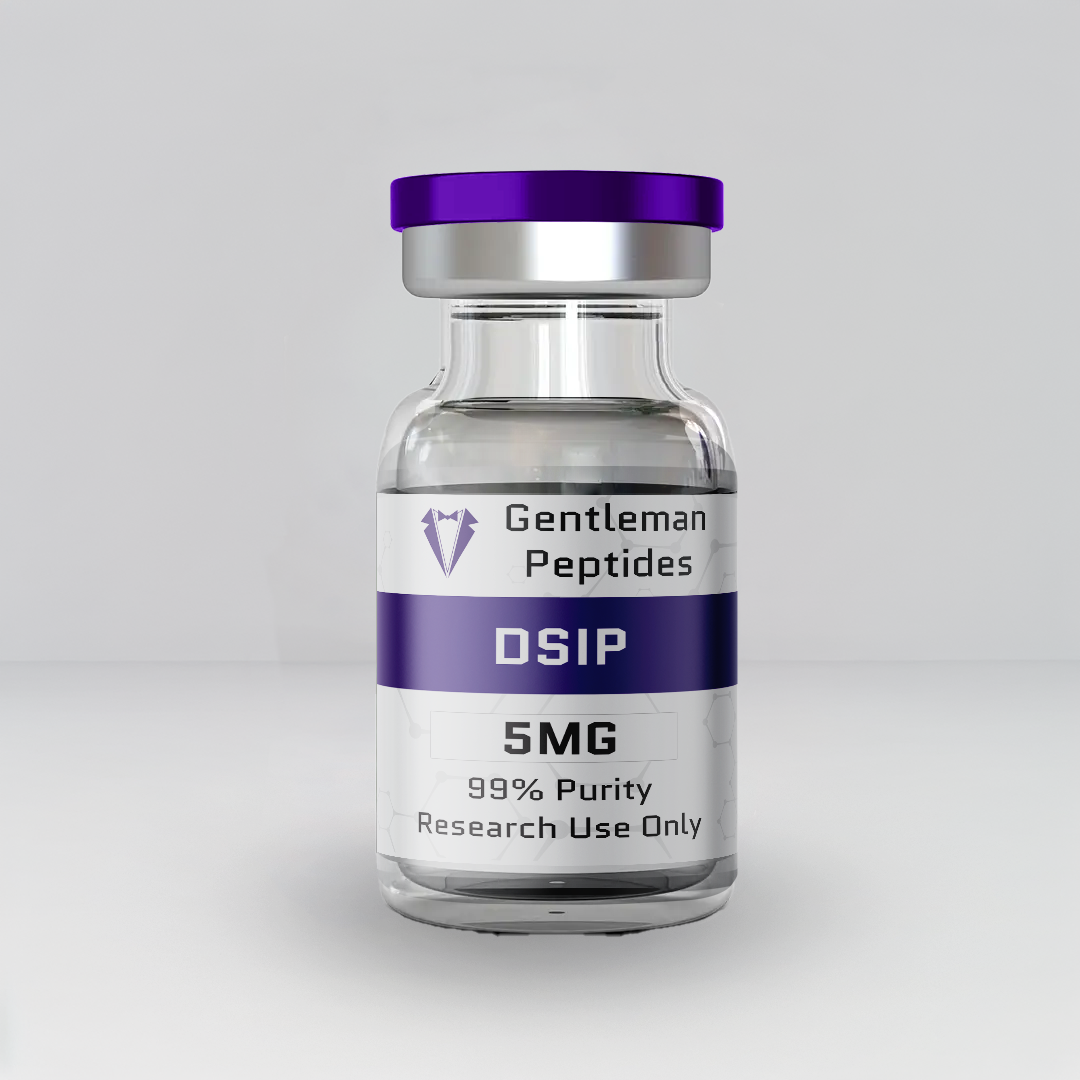

DSIP 5MG – Delta Sleep-Inducing Peptide
Overview
Delta Sleep-Inducing Peptide (DSIP), also known as emideltide, is a short peptide consisting of nine amino acids. It was first isolated during research involving rabbits in experimentally induced sleep in the 1970s.
DSIP became the subject of scientific interest because early experiments suggested a possible relationship with delta-wave activity, a brain-wave pattern associated with deep non-REM sleep.
Despite its name, DSIP has not been established as a reliable sleep treatment. Historical human studies were generally small, and their findings were inconsistent.
Product Specifications
| Specification | Details |
|---|---|
| Product name | DSIP 5MG |
| Alternative name | Delta Sleep-Inducing Peptide |
| Also known as | Emideltide |
| Category | Synthetic peptide |
| Peptide length | 9 amino acids |
| Labelled quantity | 5MG |
| Amino-acid sequence | Trp-Ala-Gly-Gly-Asp-Ala-Ser-Gly-Glu |
| Common abbreviation | DSIP |
| CAS number | 62568-57-4 for the free-base form |
| Salt form | Not confirmed |
| Batch-specific purity | Not independently verified |
Chemical identity note: DSIP free base and emideltide acetate are distinct chemical forms. The product label or appropriate analytical documentation should establish which form is present. A 5MG label alone does not establish the salt form, purity or batch composition.
Scientific Background and Structure
The DSIP peptide
DSIP is classified as a nonapeptide, meaning it contains nine amino-acid residues.
Its commonly reported sequence is:
Trp-Ala-Gly-Gly-Asp-Ala-Ser-Gly-Glu
The peptide is sometimes described in scientific literature as a neuroactive peptide because of its historical investigation in relation to sleep and neurological processes.
Delta-wave activity
Delta waves are low-frequency electrical patterns recorded through electroencephalography (EEG). They are particularly associated with deep stages of non-REM sleep.
The original research that led to DSIP’s name proposed that the peptide could influence delta-wave activity. However, later experiments did not consistently reproduce the original observations.
Receptor and signalling uncertainty
A definitive receptor responsible for DSIP’s proposed effects has not been established. Its precise biological mechanism therefore remains uncertain.
This limits the ability to explain its reported effects through a clearly defined molecular pathway.
Research Findings
1. Early animal research
The original investigations isolated DSIP from the cerebral venous blood of rabbits during experimentally induced sleep.
Early animal experiments suggested that the peptide might influence sleep-related EEG activity. These observations generated interest in its possible biological role.
However, animal findings cannot independently establish effects in humans.
2. Historical human sleep studies
Several small human studies investigated DSIP in people with sleep disturbances, including chronic insomnia.
Some early reports described changes in sleep measurements or subjective sleep experiences. Other controlled studies reported weak, insignificant or inconsistent findings.
The small sample sizes, historical study methods and differences in experimental design make the results difficult to interpret.
3. Sleep architecture research
Sleep architecture describes the distribution and progression of different sleep stages throughout the night.
Historical DSIP investigations examined measurements such as:
- Total sleep time
- Sleep onset and awakenings
- Slow-wave sleep
- REM sleep
- EEG activity
The available findings do not establish a reproducible improvement in sleep architecture or a clinically meaningful treatment effect.
4. Neurological and stress-related research
DSIP has also appeared in experimental research involving neurological activity and physiological responses to stress.
Some animal studies explored possible relationships with hormonal signalling and stress-related responses. These findings remain preliminary and do not establish a proven human application.
5. Historical withdrawal-related investigations
Older reports also examined DSIP in people experiencing alcohol or opioid withdrawal.
Some uncontrolled studies reported observations that attracted scientific interest. However, the absence of strong modern controlled evidence means these reports cannot establish safety or effectiveness for withdrawal management.
DSIP should not be presented as an established treatment for substance dependence or withdrawal.
Summary of Research Areas
| Research area | Scientific status |
|---|---|
| Sleep and insomnia | Small historical human studies with inconsistent findings |
| Delta-wave activity | Investigated in animal and human research |
| Sleep architecture | Results have not been reliably reproduced |
| Neurological activity | Mainly preliminary experimental research |
| Stress-related signalling | Early experimental investigations |
| Alcohol and opioid withdrawal | Historical reports with major evidence limitations |
| Long-term human safety | Insufficiently established |
Regulatory and Safety Considerations
DSIP is not an FDA-approved medicine.
In its May 2026 briefing document, the FDA evaluated emideltide free base and emideltide acetate for possible inclusion on the list of bulk drug substances that may be used in certain compounded medicines.
The FDA’s evaluation identified several concerns:
- Incomplete and inconsistent chemical characterization.
- Differences between free-base and acetate forms.
- Potential peptide-related impurities.
- Possible peptide aggregation and degradation.
- Uncertainty about immunogenicity.
- Insufficient evidence to establish effectiveness for the proposed uses.
The FDA concluded that the evaluation criteria weighed against adding either form to the relevant compounding list.
These regulatory concerns are particularly important when assessing the identity and quality of any product labelled DSIP.
Evidence Limitations and Scientific Considerations
The current scientific record has important limitations:
- Many human studies were conducted several decades ago.
- Controlled studies involved relatively small groups.
- Findings on sleep-related outcomes were inconsistent.
- The biological receptor and precise mechanism remain unresolved.
- Modern long-term human safety information is inadequate.
- Historical research does not establish the quality or composition of a commercial product.
- Evidence from one chemical form should not automatically be applied to another.
A product labelled DSIP 5MG should not be assumed to have a verified chemical identity, purity level, stability profile or clinical effect without appropriate documentation.
Frequently Asked Questions
What does DSIP stand for?
DSIP stands for Delta Sleep-Inducing Peptide. It is also known as emideltide.
How many amino acids does DSIP contain?
DSIP is a nonapeptide, meaning it contains nine amino acids.
Why was DSIP originally studied?
It was initially investigated because early animal experiments suggested a possible relationship with delta-wave brain activity during sleep.
Has DSIP been studied in humans?
Yes. Small historical human studies investigated sleep-related outcomes and other proposed applications. However, their results were inconsistent and do not establish a reliable clinical benefit.
Is DSIP an approved sleep medicine?
No. DSIP is not an FDA-approved medicine, and its effectiveness as a sleep treatment has not been established.
Are DSIP free base and DSIP acetate the same?
No. They are distinct chemical forms with different chemical characteristics. Product documentation should identify the form accurately.
Does the 5MG label establish product purity?
No. The labelled quantity does not establish purity, identity, sterility or batch quality. Those characteristics require appropriate analytical documentation.
Scientific References
- Monnier M. and colleagues. Early investigations of delta sleep-inducing peptide and its isolation from rabbit cerebral venous blood, 1970s.
- Schneider-Helmert D. and colleagues. Historical clinical investigations of DSIP in sleep-related research, 1981.
- Monti JM et al. Clinical investigations of DSIP in chronic insomnia, 1987. PubMed PMID: 3583493.
- Bes F et al. Clinical study of DSIP in chronic insomnia, 1992. PubMed PMID: 1299794.
- U.S. Food and Drug Administration. FDA Evaluation of Emideltide-Related Bulk Drug Substances: Emideltide (Free Base) and Emideltide Acetate. May 11, 2026.
Important Research Disclaimer
This page is provided for general scientific and educational information. It is not medical advice and does not establish that DSIP is safe, effective or approved for human use. Investigational substances should not be used for self-treatment. Product identity, chemical form, quality and regulatory status must be independently verified. Regulatory requirements vary by jurisdiction.
Be the first to review “DSIP 5MG”
Related products
PEPTIDES
PEPTIDES

PEPTIDES
PEPTIDES
PEPTIDES
PEPTIDES

PEPTIDES
PEPTIDES
Reviews
There are no reviews yet.