
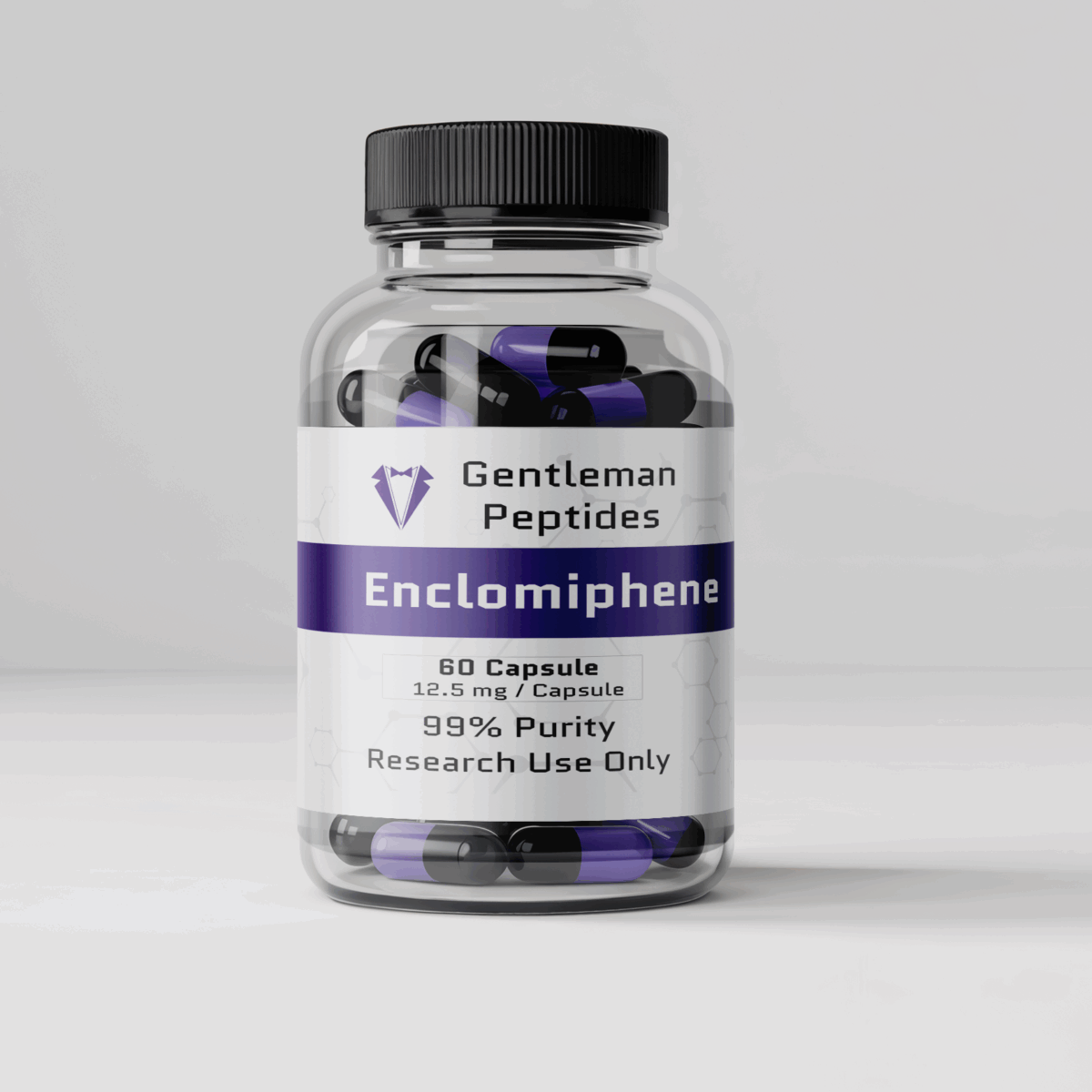

Enclo 60 Capsules – Enclomiphene Scientific Overview
Overview
Enclomiphene, commonly referred to as Enclo, is a non-steroidal selective estrogen receptor modulator (SERM). It is one of the two geometric isomers found in clomiphene citrate and is also known as trans-clomiphene or (E)-clomiphene.
Unlike peptides, enclomiphene is a small-molecule pharmaceutical compound. It has been investigated for its effects on estrogen-related feedback signalling and the hormonal regulation of testosterone production.
Clinical research has primarily examined enclomiphene in men with secondary hypogonadism. However, clinical development did not establish sufficient evidence for regulatory approval as a standalone medicine.
Product Specifications
| Specification | Details |
|---|---|
| Product name | Enclo |
| Identified compound | Enclomiphene |
| Alternative names | Enclomifene, trans-clomiphene, (E)-clomiphene |
| Category | Small-molecule pharmaceutical compound |
| Drug class | Selective estrogen receptor modulator (SERM) |
| Product format | Capsules |
| Pack size | 60 capsules |
| Strength per capsule | Not stated on the referenced listing |
| Chemical form | Citrate form should be verified |
| CAS number | 7599-79-3 for enclomiphene citrate |
| Batch-specific testing | Not independently verified |
Specification note: The 60-capsule count describes the pack size, not the amount of active ingredient. The strength per capsule, exact chemical form, excipients and batch composition should be confirmed from the product label and appropriate analytical documentation.
Scientific Background and Mechanism
What is enclomiphene?
Clomiphene is a mixture of two geometric isomers:
- Enclomiphene, the trans (E) isomer.
- Zuclomiphene, the cis (Z) isomer.
Enclomiphene can be separated from this mixture and studied as an individual compound. It is chemically distinct from the complete clomiphene mixture.
Selective estrogen receptor modulation
Enclomiphene belongs to the SERM drug class. SERMs interact with estrogen receptors and can produce different effects depending on the tissue and biological context.
Research has examined enclomiphene’s influence on estrogen-mediated feedback mechanisms involving the hypothalamus and pituitary gland.
Hormonal signalling
The hypothalamus and pituitary gland are involved in regulating reproductive hormone signalling.
In selected research populations, enclomiphene was investigated for its influence on luteinizing hormone (LH) and follicle-stimulating hormone (FSH). These hormones are involved in regulating testicular function.
Changes in hormone concentrations are biological measurements. They do not, by themselves, establish a clinically meaningful improvement in symptoms or overall health.
Research Findings
1. Secondary hypogonadism research
Clinical studies investigated enclomiphene in men diagnosed with secondary hypogonadism, a condition involving inadequate hormonal stimulation from the hypothalamus or pituitary gland.
Researchers examined changes in testosterone and reproductive hormone measurements.
The results demonstrated that enclomiphene could alter certain hormone concentrations in the studied populations. However, the FDA concluded that the available evidence did not establish sufficient clinical effectiveness for the proposed use.
2. Testosterone measurements
Some clinical trials reported increases in serum testosterone concentrations following exposure to enclomiphene.
These findings attracted interest because they provided information about hormonal signalling in selected study participants.
However, a change in a laboratory measurement does not automatically demonstrate improvement in symptoms, physical function or long-term health outcomes.
3. LH and FSH research
Studies also measured luteinizing hormone and follicle-stimulating hormone.
These hormones are involved in the regulation of reproductive function. Their concentrations were examined alongside testosterone measurements to better understand the compound’s effects on the hypothalamic-pituitary-gonadal axis.
The findings should be interpreted within the specific populations and study conditions in which they were obtained.
4. Comparison with testosterone therapy
Some clinical investigations compared enclomiphene with topical testosterone preparations.
These studies examined hormonal measurements and sperm-related outcomes.
The research suggested differences in the effects of the two approaches on LH, FSH and sperm concentration. However, the available findings do not establish that enclomiphene is a suitable replacement for approved medical treatments.
5. Clinical development and regulatory review
Enclomiphene was investigated as a potential treatment for secondary hypogonadism. Its development programme did not result in FDA approval.
In June 2022, the FDA’s Pharmacy Compounding Advisory Committee reviewed enclomiphene citrate and voted against recommending its addition to the relevant 503A bulk drug substances list.
The FDA briefing identified insufficient evidence of clinical effectiveness and several safety concerns.
Summary of Research Areas
| Research area | What was investigated |
|---|---|
| Secondary hypogonadism | Hormonal regulation in selected men |
| Testosterone | Changes in serum testosterone concentrations |
| LH and FSH | Pituitary reproductive hormone signalling |
| Sperm-related measurements | Reproductive parameters in clinical studies |
| Estrogen receptors | SERM activity and estrogen-related feedback |
| Clinical comparisons | Differences between enclomiphene and testosterone preparations |
| Long-term safety | Insufficiently established |
Safety and Regulatory Considerations
Enclomiphene is not an FDA-approved standalone medicine.
The FDA’s 2022 briefing identified reported adverse events in clinical studies, including:
- Bradycardia and atrial flutter.
- Hypotension.
- Deep vein thrombosis.
- Pulmonary embolism.
- Ischemic stroke.
- Increased estradiol.
- Increased prostate-specific antigen (PSA).
- Increased hematocrit.
The FDA also noted limitations in the available pharmacokinetic information and concluded that the evidence did not establish sufficient clinical effectiveness for the proposed use.
These findings are important when interpreting the compound’s research history. They should not be replaced with unsupported claims that the compound is safe or effective.
Evidence Limitations and Scientific Considerations
Important limitations include:
- Clinical studies have focused on selected populations, particularly men with secondary hypogonadism.
- Changes in testosterone do not necessarily establish improvement in clinical symptoms.
- Long-term safety information is limited.
- Findings for enclomiphene alone should not automatically be applied to clomiphene citrate, which contains two isomers.
- Research formulations cannot be assumed to be identical to commercially listed capsules.
- The strength, chemical form, purity and composition of this particular 60-capsule listing have not been independently verified.
Frequently Asked Questions
What is Enclo?
Enclo is a common abbreviated product name for enclomiphene, a selective estrogen receptor modulator.
Is enclomiphene a peptide?
No. Enclomiphene is a small-molecule pharmaceutical compound, not a peptide.
Is enclomiphene the same as clomiphene?
No. Enclomiphene is one of the two geometric isomers that make up clomiphene. Clomiphene citrate is a mixture, while enclomiphene refers to the isolated trans isomer.
What does SERM mean?
SERM stands for selective estrogen receptor modulator. It describes a class of compounds that interact with estrogen receptors and can have different effects in different tissues.
Has enclomiphene been approved by the FDA?
No. Enclomiphene has not received FDA approval as a standalone medicine.
Does the 60-capsule listing establish the capsule strength?
No. It establishes only the number of capsules in the package. The active ingredient amount per capsule must be confirmed separately.
Does an increase in testosterone prove clinical effectiveness?
No. Hormone measurements are laboratory endpoints. Clinical effectiveness requires evidence of meaningful improvements in health outcomes, not simply changes in hormone concentrations.
Scientific References
- U.S. Food and Drug Administration. Enclomiphene Citrate: Pharmacy Compounding Advisory Committee Briefing Document. June 8, 2022.
- U.S. Food and Drug Administration. NDA 210693 – Enclomiphene Citrate Review and Advisory Committee Materials, 2022.
- Wiehle RD et al. Clinical research comparing enclomiphene citrate and topical testosterone in men with secondary hypogonadism, 2014.
- British Society for Sexual Medicine. Position Statement for the Potential Use of Enclomiphene in the Treatment of Male Hypogonadism, 2025.
Important Research Disclaimer
This content is provided for general scientific and educational information. It is not medical advice and does not establish that enclomiphene is safe, effective, approved or suitable for human use. Enclomiphene is a pharmacologically active drug compound, not an ordinary dietary supplement. Product identity, composition, quality and regulatory status must be independently verified. Regulatory requirements vary by jurisdiction.
Be the first to review “Enclomiphene”
Related products

PEPTIDES
PEPTIDES
PEPTIDES
PEPTIDES

PEPTIDES
PEPTIDES

PEPTIDES
PEPTIDES
Reviews
There are no reviews yet.