

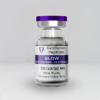

GHK-Cu Vial – Copper Tripeptide-1 Scientific Research Overview
Overview
GHK-Cu, also known as copper tripeptide-1, is a copper(II)-complexed form of the naturally occurring tripeptide glycyl-L-histidyl-L-lysine (GHK).
GHK is a short peptide made up of three amino acids: glycine, histidine and lysine. Its ability to coordinate copper ions gives rise to the GHK-Cu complex, which has been investigated in several areas of cellular and molecular biology.
Scientific research has examined GHK-Cu in relation to extracellular-matrix regulation, fibroblast activity, oxidative processes, inflammatory signalling and skin biology.
Although preclinical findings have generated scientific interest, the evidence in humans remains limited. Most human research has involved topical preparations rather than injectable products.
Product Specifications
| Specification | Details |
|---|---|
| Product name | GHK-Cu Vial |
| Scientific name | Copper tripeptide-1 |
| Peptide component | Glycyl-L-histidyl-L-lysine |
| Common abbreviation | GHK-Cu |
| Category | Copper-binding tripeptide complex |
| Peptide length | 3 amino acids |
| Copper component | Copper(II) |
| Product format | Vial |
| Labelled quantity | Not confirmed |
| Copper-to-peptide ratio | Not independently verified |
| Salt or formulation details | Not confirmed |
| Batch-specific purity | Not independently verified |
Chemical identity note: GHK and GHK-Cu are not identical. GHK-Cu refers to the copper-associated complex. The actual copper occupancy, chemical speciation, counterions and formulation of a particular vial require appropriate analytical documentation.
Scientific Background and Structure
1. The GHK tripeptide
GHK is a naturally occurring tripeptide consisting of:
- Glycine (Gly)
- Histidine (His)
- Lysine (Lys)
Its amino-acid sequence is Gly-His-Lys.
GHK has been studied for its ability to interact with copper ions and for its biological activity in experimental cellular systems.
2. Copper complex formation
Copper is an essential trace element involved in numerous biological processes.
GHK can coordinate copper(II), forming the GHK-Cu complex. This interaction is important because copper availability and binding can influence the chemical behaviour of the resulting complex.
The precise chemical state of a GHK-Cu preparation can depend on factors such as copper occupancy, pH, formulation, stability and the presence of other substances.
3. Extracellular-matrix research
The extracellular matrix is the network of proteins and other molecules surrounding cells. It contributes to tissue structure, cellular communication and the regulation of biological processes.
GHK-Cu has been investigated in experimental models involving fibroblasts and extracellular-matrix components, including collagen, elastin and proteoglycans.
These findings provide a basis for further investigation but do not independently establish clinical effects in humans.
Research Findings
1. Fibroblast and cellular research
Fibroblasts are connective-tissue cells involved in producing and maintaining extracellular-matrix components.
Laboratory studies have examined GHK-Cu in relation to fibroblast activity and the expression of proteins associated with the extracellular matrix.
Reported experimental areas include collagen-related processes, elastin-associated pathways and proteoglycan expression.
The findings are primarily preclinical and should not be interpreted as proof of a clinical outcome.
2. Collagen and extracellular-matrix signalling
Collagen is an important structural protein found in connective tissues.
Research involving GHK-Cu has explored molecular pathways associated with collagen production and extracellular-matrix organization.
Some laboratory and animal studies have reported changes in matrix-related gene expression and protein activity.
However, results from individual experimental models cannot establish that a particular vial produces a measurable effect in human tissue.
3. Inflammatory and oxidative processes
GHK-Cu has been investigated in experimental models involving inflammatory signalling and oxidative regulation.
Oxidative stress refers to an imbalance between reactive chemical species and the biological systems that regulate them.
Researchers have examined whether GHK-Cu influences selected molecular pathways associated with these processes.
These observations remain investigational. They do not establish that GHK-Cu is an approved anti-inflammatory or antioxidant treatment.
4. Angiogenesis and cellular signalling
Angiogenesis is the formation of new blood vessels from existing vascular structures.
Preclinical research has examined GHK-Cu in relation to angiogenesis and other cellular signalling pathways.
Such investigations help researchers understand possible interactions between copper-associated peptides and biological systems.
The findings do not establish a proven therapeutic effect or a specific clinical application.
5. Skin-related research
GHK-Cu has received attention in cosmetic and dermatological research, particularly in studies involving topical formulations.
Small human studies and experimental research have examined outcomes such as skin appearance, wrinkle measurements and skin-related structural markers.
However, the human evidence is limited and mixed. A small controlled study following CO2 laser treatment did not demonstrate an objective advantage on its main measured outcomes.
A recent review also highlighted the limited size and chemical characterization of the available human studies.
Importantly, findings involving creams, gels or other topical formulations cannot automatically be applied to a vial intended for a different route of administration.
6. Wound-related experimental research
GHK-Cu has been investigated in cell and animal models involving tissue repair and extracellular-matrix processes.
Some historical human research has also examined topical preparations in wound-related settings.
The evidence is not sufficient to establish GHK-Cu as an approved wound-treatment product. Results from topical preparations do not establish the safety or effectiveness of injectable GHK-Cu.
Summary of Research Areas
| Research area | Scientific evidence |
|---|---|
| Fibroblast biology | Laboratory and preclinical investigations |
| Collagen-related pathways | Experimental research |
| Extracellular-matrix regulation | Preclinical findings |
| Oxidative processes | Experimental investigations |
| Inflammatory signalling | Primarily preclinical evidence |
| Angiogenesis | Laboratory and animal research |
| Skin-related research | Limited human topical studies |
| Wound-related research | Preclinical and limited historical human evidence |
| Injectable human research | Insufficient evidence |
Regulatory and Safety Considerations
GHK-Cu is not an FDA-approved injectable medicine.
The FDA has specifically identified concerns involving compounded injectable GHK-Cu. These include:
- Potential immunogenicity associated with peptide aggregation.
- Peptide-related impurities.
- Limited human safety information.
- Challenges in adequately characterizing the chemical substance.
The FDA’s 2026 compounding materials distinguish injectable GHK-Cu from non-injectable routes. The agency’s May 2026 update also indicated that it intended to consult its Pharmacy Compounding Advisory Committee about possible inclusion of non-injectable GHK-Cu before the end of February 2027.
Being evaluated for possible inclusion on a compounding list is not the same as FDA approval.
Evidence Limitations and Scientific Considerations
Several important limitations should be considered when reviewing GHK-Cu research:
- A substantial portion of the evidence comes from cell and animal experiments.
- Human studies are relatively small and often involve topical formulations.
- There is insufficient human evidence to establish injectable GHK-Cu safety and effectiveness.
- GHK and GHK-Cu should not be treated as chemically identical.
- Copper occupancy and chemical speciation can affect the identity of a preparation.
- Research involving one formulation or delivery method cannot automatically be applied to another.
- A product label does not independently establish purity, sterility, copper content or batch consistency.
The identity and composition of a particular vial should be supported by suitable analytical documentation.
Frequently Asked Questions
What does GHK-Cu stand for?
GHK-Cu stands for glycyl-L-histidyl-L-lysine copper complex. It is also known as copper tripeptide-1.
Is GHK-Cu a peptide?
Yes. Its peptide component, GHK, contains three amino acids. GHK-Cu is the copper-associated form of that tripeptide.
What is the difference between GHK and GHK-Cu?
GHK is the uncomplexed tripeptide. GHK-Cu refers to the form associated with copper(II). They should be identified separately in scientific descriptions.
What has GHK-Cu been studied for?
Research has examined extracellular-matrix biology, fibroblast activity, collagen-related pathways, oxidative processes, inflammatory signalling and skin-related biology.
Is GHK-Cu FDA-approved for injection?
No. GHK-Cu is not an FDA-approved injectable medicine. The FDA has also identified specific safety concerns regarding compounded injectable preparations.
Do topical GHK-Cu studies establish the effectiveness of a vial?
No. A topical cream or gel and a vial intended for another route may have different formulation, exposure and safety characteristics. Evidence from one cannot automatically establish the properties of the other.
Does the vial format establish the amount of GHK-Cu?
No. The vial format alone does not establish the total peptide quantity, copper content, concentration or chemical composition.
Scientific References
- Pickart L. and colleagues. Research on glycyl-L-histidyl-L-lysine and copper-associated peptide biology.
- Pickart L, Margolina A. Regenerative and Protective Actions of the GHK-Cu Peptide in the Light of the New Gene Data. International Journal of Molecular Sciences, 2018.
- Badenhorst T. and colleagues. Experimental research involving GHK-Cu and skin-related outcomes, 2016.
- U.S. Food and Drug Administration. Certain Bulk Drug Substances for Use in Compounding That May Present Significant Safety Risks – GHK-Cu injectable safety considerations.
- U.S. Food and Drug Administration. Bulk Drug Substances Nominated for Use in Compounding Under Section 503A, updated May 14, 2026.
- GHK-Cu as a Bioactive Metallopeptide and Drug-Delivery Cargo: Coordination Chemistry, Formulation Science, Therapeutic Evidence, and a Translational Roadmap. 2026.
Important Research Disclaimer
This page is provided for general scientific and educational information. It is not medical advice and does not establish that GHK-Cu is safe, effective or approved for human use. Investigational compounds should not be used for self-treatment. Product identity, copper content, chemical composition, quality and regulatory status must be independently verified. Regulatory requirements vary by jurisdiction.
Be the first to review “GHK-CU Vial”
Related products
PEPTIDES
PEPTIDES
PEPTIDES

PEPTIDES
PEPTIDES
PEPTIDES
PEPTIDES

PEPTIDES
Reviews
There are no reviews yet.