
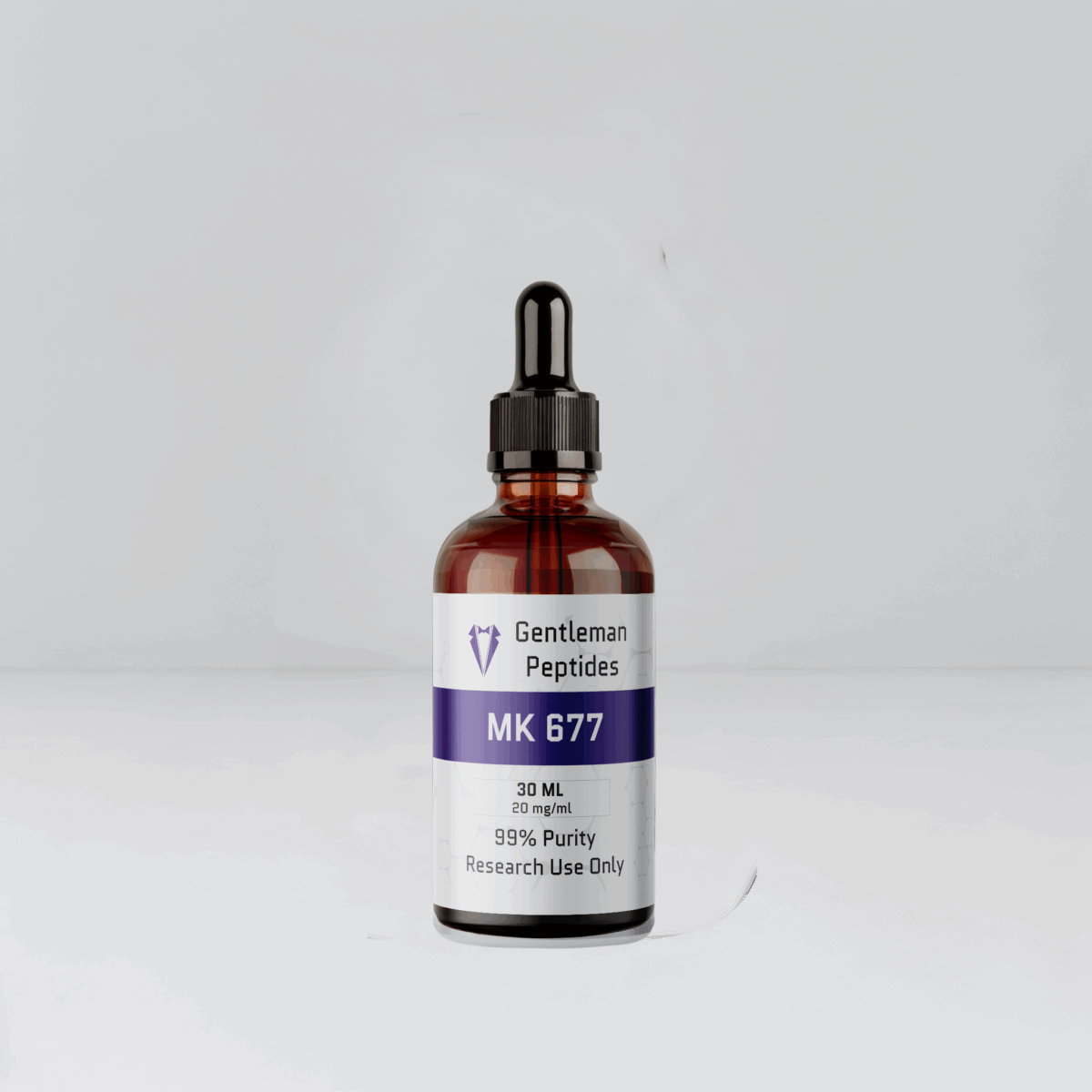


MK-677 Liquid 30ML – Scientific Overview and Research Information
What Is MK-677?
MK-677, also known as Ibutamoren or MK-0677, is an orally active, non-peptide compound investigated for its effects on growth hormone secretion.
It belongs to a class of compounds known as growth hormone secretagogues. These compounds stimulate growth hormone release through interactions with the ghrelin receptor, also known as the growth hormone secretagogue receptor (GHS-R1a).
Unlike growth hormone itself, MK-677 is not a peptide hormone. It is a synthetic small molecule that has been studied for its ability to influence the body’s endogenous growth hormone pathway.
Research involving MK-677 has examined growth hormone secretion, insulin-like growth factor 1 (IGF-1), body composition, bone metabolism, appetite regulation and glucose homeostasis.
This product is presented as a liquid formulation with a listed bottle volume of 30ML. The concentration of active ingredient per millilitre must be established separately through product-specific documentation.
Product Specifications
| Specification | Details |
|---|---|
| Product Name | MK-677 Liquid |
| Alternative Names | Ibutamoren, MK-0677 |
| Listed Bottle Volume | 30ML |
| Compound Type | Synthetic small molecule |
| Chemical Classification | Growth hormone secretagogue |
| Primary Biological Target | Ghrelin receptor (GHS-R1a) |
| Related Hormone | Growth hormone (GH) |
| Related Growth Factor | Insulin-like growth factor 1 (IGF-1) |
| Research Areas | GH secretion, IGF-1 regulation and metabolic research |
| Formulation | Liquid |
| Active Ingredient Concentration | Not specified |
| Total Active Ingredient | Requires concentration and formulation verification |
The 30ML designation refers to the stated liquid volume. It does not establish the amount of active ingredient in the bottle. Concentration, total content, chemical form, carrier ingredients and batch identity should be confirmed using the actual product label and supporting analytical documentation.
Understanding the Ghrelin Receptor
The ghrelin receptor, GHS-R1a, is a G-protein-coupled receptor involved in growth hormone secretion and other physiological processes.
Ghrelin is a naturally occurring hormone that interacts with this receptor.
MK-677 acts as a ghrelin mimetic, meaning that it can activate the receptor and stimulate growth hormone release.
1. Growth Hormone Secretion
Growth hormone is produced by the anterior pituitary gland. It participates in growth, metabolism, tissue maintenance and the regulation of other hormones.
MK-677 has been investigated for its ability to increase pulsatile growth hormone secretion.
2. Insulin-Like Growth Factor 1
IGF-1 is a growth factor produced primarily by the liver in response to growth hormone signalling.
It is involved in cellular growth, differentiation and metabolic regulation.
Human clinical studies have examined changes in circulating IGF-1 concentrations following exposure to MK-677.
3. Ghrelin-Related Biological Activity
Ghrelin is also involved in appetite regulation and energy balance.
Because MK-677 interacts with the ghrelin receptor, appetite-related effects have been observed in clinical research.
This receptor activity is an important consideration when interpreting the compound’s metabolic effects.
What Does Research Show About MK-677?
Research involving MK-677 has examined its influence on the growth hormone and IGF-1 pathways in human participants and experimental models.
Several clinical studies have investigated its biological activity. However, evidence of hormonal changes does not automatically establish a favourable risk-benefit profile or an approved medical application.
1. Research into Growth Hormone Secretion
A study published in the Journal of Clinical Endocrinology and Metabolism in 1996 investigated the effects of orally administered MK-677 on growth hormone secretion in healthy older adults.
Chapman and colleagues conducted a randomized, double-blind, placebo-controlled study involving 32 participants aged 64–81.
The researchers examined different doses and measured growth hormone, prolactin and cortisol concentrations.
The study reported increased growth hormone concentrations and corresponding increases in circulating IGF-1.
Research significance: This study provided early human evidence that MK-677 could stimulate the growth hormone and IGF-1 pathways.
2. Research into Body Composition
A randomized, double-blind study published in the Journal of Clinical Endocrinology and Metabolism in 1998 examined MK-677 in otherwise healthy obese men.
Twenty-four participants received MK-677 or placebo over an eight-week period.
Researchers investigated growth hormone secretion, IGF-1 concentrations, body composition and energy expenditure.
The study reported increased growth hormone and IGF-1 concentrations. Fat-free mass also increased during the study period.
However, total fat mass and visceral fat did not significantly decrease.
The researchers also observed impaired glucose homeostasis during oral glucose tolerance testing.
Research significance: The findings demonstrated changes in selected body-composition measurements but did not establish a reduction in body fat or a clinical benefit.
3. Research into Long-Term Body Composition
A randomized clinical trial published in Annals of Internal Medicine in 2008 investigated MK-677 in healthy older adults.
The study involved 65 participants aged 60–81 and examined treatment over a longer period than earlier investigations.
Researchers measured growth hormone, IGF-1, fat-free mass, body composition, insulin sensitivity, bone mineral density and physical function.
The study reported increases in growth hormone, IGF-1 and fat-free mass in the MK-677 group.
However, the increase in fat-free mass did not translate into measurable improvements in strength or physical function.
Researchers also observed increased fasting blood glucose and reduced insulin sensitivity.
Other reported findings included increased appetite, mild lower-extremity swelling and muscle discomfort.
Research significance: This study demonstrated that changes in hormone concentrations and body composition do not necessarily produce corresponding improvements in physical performance or function.
4. Research into Bone Metabolism
Growth hormone and IGF-1 are involved in bone development and remodelling.
Researchers have investigated whether MK-677 influences biochemical markers associated with bone formation and resorption.
A study published in the Journal of Bone and Mineral Research in 1999 examined MK-677 in healthy and functionally impaired older adults.
The researchers reported increases in serum IGF-1 and several biochemical markers associated with bone turnover.
These findings provided evidence that stimulating the growth hormone pathway can influence bone-related metabolic measurements.
However, changes in biochemical markers do not independently demonstrate improvements in bone strength or reductions in fracture risk.
Research significance: The study contributed to research into the relationship between growth hormone signalling and bone metabolism.
5. Research into Glucose Regulation
Glucose regulation is an important consideration in studies involving MK-677.
Growth hormone can influence insulin sensitivity and glucose metabolism.
Several clinical investigations have therefore monitored fasting glucose, insulin concentrations and glucose tolerance during MK-677 studies.
The 1998 study involving obese men reported impaired glucose homeostasis during oral glucose tolerance testing.
The longer-term study involving older adults also reported increased fasting glucose and reduced insulin sensitivity.
These findings demonstrate why glucose metabolism is an important consideration in research involving growth hormone secretagogues.
Research significance: Clinical research has identified metabolic changes that should be considered alongside hormonal findings.
6. Research into Alzheimer’s Disease
MK-677 has also been investigated in a large clinical study involving people with mild to moderate Alzheimer’s disease.
A randomized, double-blind, multicentre study published in Neurology in 2008 included 563 participants who received MK-677 or placebo over 12 months.
The researchers examined whether increasing IGF-1 concentrations would influence the progression of Alzheimer’s disease.
Although the study reported increased IGF-1 concentrations in participants receiving MK-677, it did not identify significant improvements in the principal measures of disease progression.
Research significance: This study illustrates that increasing a biological marker does not necessarily produce a corresponding clinical improvement.
7. Research into Safety and Regulatory Considerations
The safety profile of MK-677 remains an important subject of scientific and regulatory evaluation.
The US Food and Drug Administration reviewed information on ibutamoren mesylate during its October 2024 Pharmacy Compounding Advisory Committee evaluation.
The evaluation discussed clinical findings involving glucose regulation and insulin sensitivity, as well as a potential congestive-heart-failure safety signal in certain patients in a hip-fracture study.
Other reported findings across clinical investigations include increased appetite, fluid retention, muscle discomfort and changes in glucose metabolism.
Research significance: These findings highlight the importance of evaluating safety outcomes alongside changes in growth hormone and IGF-1 concentrations.
Understanding Liquid Formulations
A liquid formulation is a preparation in which an active ingredient is present in a liquid carrier.
When reviewing a liquid compound, researchers and analytical laboratories distinguish between several separate specifications.
Bottle volume: The total volume of liquid contained in the bottle. For this listing, the stated volume is 30ML.
Concentration: The amount of active ingredient present in each millilitre, usually expressed in MG/ML.
Total active ingredient: The total amount of compound contained in the bottle. This depends on both concentration and total liquid volume.
Chemical identity: Confirmation of the exact active ingredient and its chemical form.
Carrier composition: Identification of the solvents, excipients or other carrier materials used in the formulation.
Analytical verification: Appropriate testing to establish the identity, concentration and composition of the finished liquid preparation.
A bottle marked 30ML should therefore not be interpreted as containing 30MG or any other particular amount of MK-677 unless the concentration is independently specified.
Summary of Research Areas
| Research Area | Scientific Focus | Evidence Type |
|---|---|---|
| Growth Hormone Secretion | Stimulation of pulsatile GH release | Human clinical research |
| IGF-1 Regulation | Changes in circulating IGF-1 | Human clinical research |
| Body Composition | Fat-free mass and body-composition measurements | Human clinical research |
| Bone Metabolism | Biochemical markers of bone turnover | Human clinical research |
| Glucose Regulation | Fasting glucose and insulin sensitivity | Human clinical research |
| Appetite Regulation | Ghrelin-receptor-related effects | Human clinical research |
| Alzheimer’s Disease | Evaluation of cognitive and functional outcomes | Randomized clinical research |
| Liquid Formulation Analysis | Concentration, identity and carrier composition | Analytical research |
Evidence Limitations and Scientific Considerations
Although MK-677 has been examined in human clinical trials, several important limitations remain.
Investigational status: MK-677 is not an FDA-approved medicine. Clinical investigation does not mean that a compound has received regulatory approval.
Glucose regulation: Clinical studies have reported changes in fasting glucose and insulin sensitivity. These findings are important considerations when evaluating its safety.
Fluid retention and appetite: Increased appetite and mild swelling have been reported in clinical studies.
Body composition is not equivalent to physical performance: Increases in fat-free mass do not necessarily demonstrate improvements in strength or physical function.
Cardiovascular safety: The FDA has discussed a potential congestive-heart-failure safety signal in its evaluation of ibutamoren mesylate.
Liquid concentration requires verification: The stated bottle volume alone does not establish the amount of active ingredient.
Finished formulation quality matters: Analytical documentation for a raw ingredient does not automatically verify the concentration, identity or quality of a finished liquid formulation.
Long-term safety remains uncertain: Existing studies do not establish a universally safe long-term profile across different populations.
Overall, MK-677 liquid is best understood as a liquid-form preparation of an investigational growth hormone secretagogue. Its scientific background relates to ghrelin-receptor activity, growth hormone secretion and IGF-1 regulation.
Frequently Asked Questions
What is MK-677 Liquid?
MK-677 liquid is a liquid-form preparation of Ibutamoren, a non-peptide compound investigated for its effects on growth hormone secretion.
Is MK-677 a peptide?
No. MK-677 is a synthetic small molecule rather than an amino-acid chain.
Is MK-677 a SARM?
No. MK-677 is not a selective androgen receptor modulator. It acts through the ghrelin receptor, also known as GHS-R1a.
What does Ibutamoren mean?
Ibutamoren is the alternative name commonly used for MK-677. MK-0677 is another designation for the compound.
What is the relationship between MK-677 and IGF-1?
MK-677 stimulates growth hormone secretion, which can subsequently increase circulating IGF-1 concentrations.
What has MK-677 been studied for?
Research has examined growth hormone secretion, IGF-1 regulation, body composition, bone metabolism, glucose regulation and other related biological processes.
Has MK-677 been studied in humans?
Yes. Several randomized clinical studies have investigated its biological effects and safety in human participants.
What does 30ML mean?
30ML refers to the stated volume of liquid in the bottle. It does not indicate the total amount of active ingredient.
What is the concentration of MK-677 Liquid?
The concentration must be confirmed from the actual product label or batch documentation. Bottle volume alone cannot establish the amount of MK-677 per millilitre.
Is MK-677 an approved medicine?
MK-677 is not an FDA-approved medicine. Its investigational status should not be confused with approval for general human consumption or treatment.
What safety considerations have been reported?
Clinical and regulatory evaluations have identified concerns involving glucose regulation, insulin sensitivity, fluid retention and a potential cardiovascular safety signal.
Scientific References
- Chapman IM, Pescovitz OH, Murphy G, et al. (1996). Stimulation of the growth hormone (GH)-insulin-like growth factor I axis by daily oral administration of a GH secretagogue (MK-677) in healthy elderly subjects. The Journal of Clinical Endocrinology & Metabolism, 81(12), 4249–4257.
DOI: https://doi.org/10.1210/jcem.81.12.4249
PMID: https://pubmed.ncbi.nlm.nih.gov/8954023/ - Svensson J, Lönn L, Jansson JO, et al. (1998). Two-month treatment of obese subjects with the oral growth hormone (GH) secretagogue MK-677 increases GH secretion, fat-free mass, and energy expenditure. The Journal of Clinical Endocrinology & Metabolism, 83(2), 362–369.
PMID: https://pubmed.ncbi.nlm.nih.gov/9467542/ - Oral administration of the growth hormone secretagogue MK-677 increases markers of bone turnover in healthy and functionally impaired elderly adults. (1999). Journal of Bone and Mineral Research.
PMID: https://pubmed.ncbi.nlm.nih.gov/10404019/ - Nass R, Pezzoli SS, Oliveri MC, et al. (2008). Effects of an oral ghrelin mimetic on body composition and clinical outcomes in healthy older adults: A randomized, controlled trial. Annals of Internal Medicine, 149(9), 601–611.
DOI: https://doi.org/10.7326/0003-4819-149-9-200811040-00003
Full text: https://pmc.ncbi.nlm.nih.gov/articles/PMC2757071/ - Sevigny JJ, Ryan JM, van Dyck CH, et al. (2008). Growth hormone secretagogue MK-677: No clinical effect on Alzheimer’s disease progression in a randomized trial. Neurology, 71(21), 1702–1708.
DOI: https://doi.org/10.1212/01.wnl.0000335163.88054.e7
PMID: https://pubmed.ncbi.nlm.nih.gov/19015485/ - US Food and Drug Administration. (2024). Ibutamoren Mesylate: Pharmacy Compounding Advisory Committee Evaluation.
https://www.fda.gov/media/182087/download
Important Research Disclaimer
MK-677 Liquid 30ML is described here for scientific and educational reference. MK-677 is an investigational compound and is not an FDA-approved medicine.
Clinical studies have examined its biological activity, but this does not establish an approved therapeutic application or a generally accepted safety profile.
The information presented is not medical advice and should not be interpreted as a recommendation for human or animal consumption, self-administration, diagnosis, treatment, cure or prevention of any disease.
Product identity, concentration, total active ingredient, carrier composition and batch-related claims should be supported by appropriate analytical documentation. Applicable laws and regulatory requirements should be reviewed before any product is offered or supplied.
Be the first to review “MK-677 Liquid – 30ML”
Related products

PEPTIDES

PEPTIDES

PEPTIDES
PEPTIDES
PEPTIDES

PEPTIDES
PEPTIDES

PEPTIDES
Reviews
There are no reviews yet.