


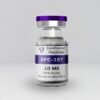
BPC-157 5MG – Scientific Overview and Research Information
Overview of BPC-157 5MG
BPC-157 is a synthetic pentadecapeptide, meaning it consists of a chain of 15 amino acids. It is based on a sequence associated with a larger protein found in gastric research and has been investigated in laboratory and animal studies for its biological activity.
Scientific interest in BPC-157 has focused on several areas, including gastrointestinal biology, cellular signalling, vascular responses and musculoskeletal tissue models. Much of the published research is preclinical, meaning it has been conducted using cells or animal models rather than adequately controlled human clinical trials.
The 5MG designation identifies the stated quantity associated with this product presentation. It does not independently establish the compound’s purity, sterility, concentration after preparation or analytical quality.
Product Specifications
| Attribute | Details |
|---|---|
| Product name | BPC-157 5MG |
| Compound classification | Synthetic peptide |
| Peptide length | 15 amino acids |
| Product presentation | Vial, as listed |
| Stated quantity | 5MG |
| Research classification | Investigational compound |
| Sequence | GEPPPGKPADDAGLV |
| Analytical documentation | Not independently verified |
| Purity | Requires batch-specific documentation |
Important: The precise chemical form, such as free base or acetate salt, should be confirmed from the manufacturer’s product documentation before being included as a definitive specification.
Scientific Background of BPC-157
BPC-157 has been studied as a biologically active peptide in a range of experimental models. Researchers have examined its possible relationship with cellular responses, gastrointestinal processes, vascular signalling and tissue-related biological pathways.
The peptide’s proposed mechanisms are not fully established. Several mechanisms have been discussed in preclinical literature, but findings from animal experiments cannot automatically be applied to humans.
1. Gastrointestinal Research
One major area of BPC-157 research involves gastrointestinal biology.
Experimental studies have investigated its activity in models involving the stomach, intestinal tissues and gastrointestinal injury. Researchers have explored cellular responses and biological processes associated with gastrointestinal integrity.
These findings are primarily preclinical. They do not establish BPC-157 as an effective or approved treatment for gastrointestinal disorders.
2. Musculoskeletal Research
BPC-157 has also been investigated in experimental models involving tendons, ligaments, muscles and other connective tissues.
Some animal and laboratory studies have examined cellular activity, tissue responses and signalling processes in these models.
Although these findings have generated scientific interest, they do not establish clinical benefits in people. Controlled human research remains insufficient to determine whether the observed experimental effects translate into meaningful outcomes.
3. Cellular Signalling and Vascular Biology
Another research area concerns possible interactions with cellular signalling and vascular processes.
Published preclinical studies have discussed pathways involving nitric oxide signalling, growth-factor-related activity and vascular responses.
These mechanisms remain under investigation. Their precise contribution to BPC-157’s observed biological activity has not been conclusively established.
Research Findings and Scientific Areas of Interest
Gastrointestinal Models
Animal studies have investigated BPC-157 in different gastrointestinal experimental settings. These studies have examined biological responses involving gastric and intestinal tissues.
The results provide a basis for further investigation, but they should not be interpreted as proof of effectiveness in human gastrointestinal conditions.
Tendon and Ligament Models
Preclinical research has examined BPC-157 in tendon-related cellular and animal models. Some experiments have focused on cell migration, cellular survival and tissue-associated responses.
These findings remain experimental and require confirmation through appropriately designed clinical studies.
Muscle and Connective-Tissue Models
Researchers have explored BPC-157 in animal models involving muscle and connective-tissue responses. These studies contribute to the broader scientific literature on the peptide.
However, animal-model findings cannot establish human recovery, healing or performance outcomes.
Pharmacological and Formulation Research
The development of BPC-157 as a potential pharmaceutical compound also raises questions about its chemical identity, stability, formulation, absorption, metabolism and pharmacokinetics.
These characteristics require more systematic investigation. Different chemical forms and product formulations should not be assumed to have identical properties.
Summary of Research Areas
| Research area | What has been investigated | Evidence status |
|---|---|---|
| Gastrointestinal biology | Experimental gastrointestinal models | Primarily preclinical |
| Tendon and ligament biology | Cellular and animal models | Primarily preclinical |
| Muscle-related research | Experimental tissue responses | Limited |
| Cellular signalling | Proposed molecular pathways | Not fully established |
| Vascular biology | Experimental vascular responses | Primarily preclinical |
| Human pharmacology | Limited exploratory research | Insufficient |
Evidence Limitations and Scientific Considerations
Despite the volume of preclinical literature, important questions about BPC-157 remain unanswered.
The United States Food and Drug Administration (FDA) has evaluated BPC-157-related bulk drug substances and identified significant gaps in the available safety information.
In its July 2026 evaluation, the FDA concluded that available information was insufficient to characterize the safety profile of BPC-157 free base and BPC-157 acetate. The agency also identified concerns involving possible immunogenicity, peptide-related impurities and inadequate characterization of the active ingredient.
The FDA’s evaluation weighed against placing these substances on the 503A Bulks List. This is a compounding-related regulatory assessment, not an approval for human use.
Other important limitations include:
- Limited controlled human clinical evidence.
- Incomplete understanding of pharmacokinetics.
- Uncertainty regarding the peptide’s precise mechanisms.
- Insufficient long-term safety information.
- The need for reliable chemical and analytical characterization.
- Uncertainty about whether findings from animal studies apply to humans.
For these reasons, BPC-157 should be described as an investigational peptide rather than an established therapeutic compound.
Frequently Asked Questions About BPC-157 5MG
What is BPC-157?
BPC-157 is a synthetic peptide consisting of 15 amino acids. It has been investigated in laboratory and animal research involving gastrointestinal biology, cellular signalling and musculoskeletal tissue models.
What does 5MG mean?
The 5MG designation refers to the stated quantity of the compound in this product presentation. It does not describe purity, concentration after preparation or sterility.
Is BPC-157 a naturally occurring peptide?
BPC-157 is synthetic. Its sequence is associated with research into a larger protein found in gastric biological material.
Has BPC-157 been approved as a medicine?
BPC-157 is not an FDA-approved drug. Its regulatory status may differ across countries, and local requirements should be checked.
Is there sufficient human research on BPC-157?
No. Human research remains limited, and the available evidence is insufficient to establish its safety or clinical effectiveness.
What scientific areas have been studied?
Research has explored gastrointestinal models, tendon and ligament biology, muscle-related models, cellular signalling and vascular responses. Most findings come from preclinical experiments.
Does the 5MG designation confirm product quality?
No. A stated quantity alone does not confirm identity, purity, sterility or analytical quality. Those characteristics require appropriate product-specific documentation.
Scientific References
- U.S. Food and Drug Administration. (2026). BPC-157-related bulk drug substances: FDA evaluation for the Pharmacy Compounding Advisory Committee, July 23–24, 2026.
- U.S. Food and Drug Administration. (2026). Certain Bulk Drug Substances for Use in Compounding that May Present Significant Safety Risks.
- BPC-157 as an Investigational Peptide Therapeutic: Biopharmaceutical Challenges, Formulation Strategies, and Translational Development Barriers. Pharmaceuticals, 2026.
- Regeneration or Risk? A Narrative Review of BPC-157 for Musculoskeletal Healing. 2025.
Important Research Disclaimer
The information on this page is provided for scientific and educational reference. BPC-157 is an investigational compound and is not an FDA-approved medicine. The information presented does not establish safety, effectiveness or suitability for human or veterinary use.
Product identity, chemical form, quantity and analytical quality should be supported by appropriate documentation. Regulatory requirements vary by jurisdiction. This page does not provide medical advice or instructions for human administration.
Be the first to review “BPC-157 5mg”
Related products

PEPTIDES

PEPTIDES
PEPTIDES
PEPTIDES

PEPTIDES
PEPTIDES
PEPTIDES
PEPTIDES
Reviews
There are no reviews yet.