
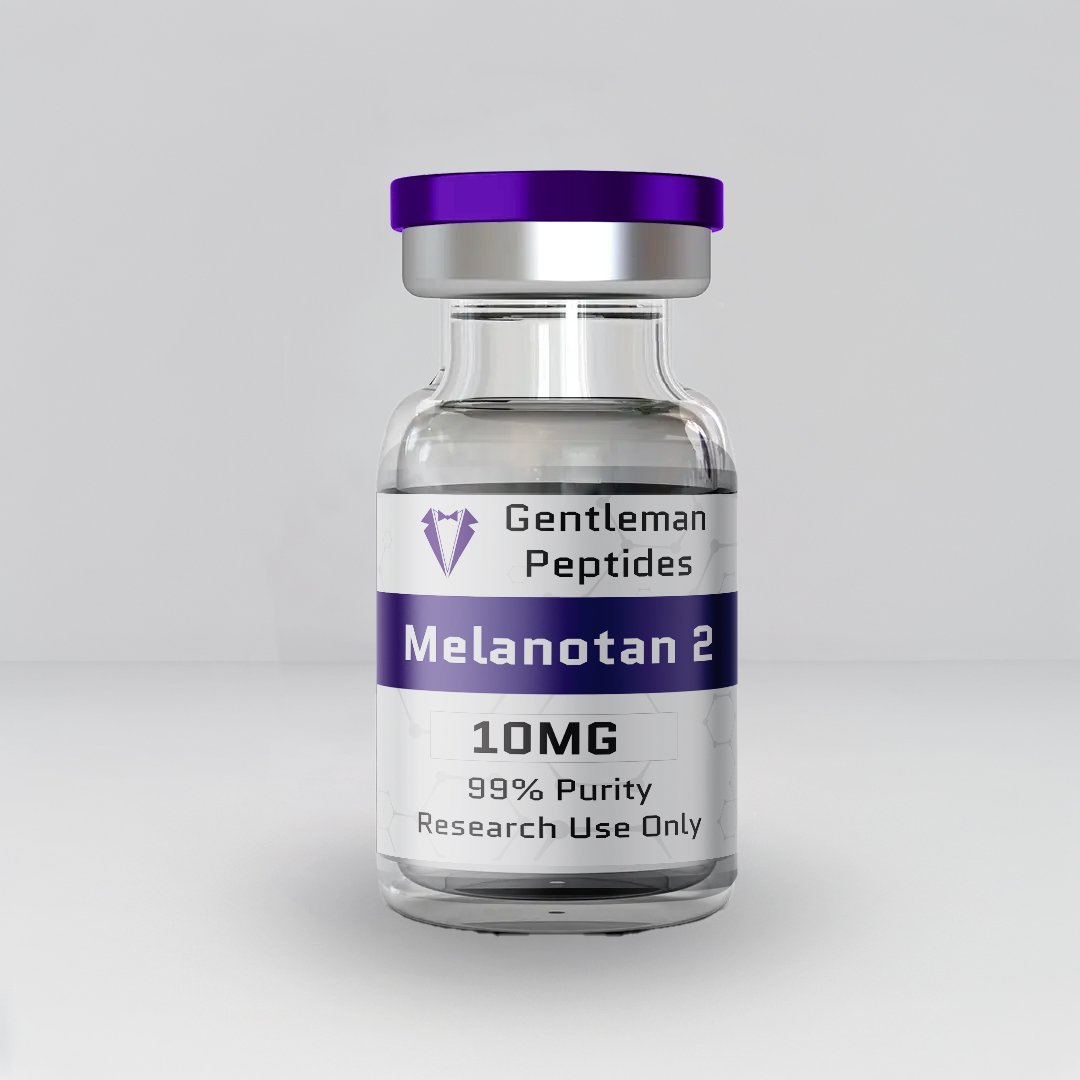
Buy MT2 10mg Online – MT2 10mg For Sale at Gentleman Peptides
Are you looking to buy MT2 10mg for your laboratory use? MT2, commonly known as Melanotan II, is a synthetic cyclic peptide analogue of alpha-melanocyte-stimulating hormone (α-MSH).
It was developed during research into melanocortin signalling and biological processes associated with skin pigmentation. Unlike more selective melanocortin compounds, Melanotan II interacts with multiple melanocortin receptor subtypes.
Scientific interest in Melanotan II has included melanogenesis, receptor activity, pigmentation pathways and other biological processes regulated by the melanocortin system.
Despite its research history, Melanotan II is not an approved medicine for tanning or any other therapeutic indication. Its safety has not been established, and serious adverse events have been reported.
MT2 10MG Product Specifications
| Specification | Details |
|---|---|
| Product name | MT2 10MG |
| Alternative name | Melanotan II |
| Compound class | Synthetic cyclic peptide |
| Related natural peptide | Alpha-melanocyte-stimulating hormone (α-MSH) |
| Main research system | Melanocortin receptors |
| Product category | Vials |
| Stated quantity | 10MG |
| Molecular form | Synthetic peptide analogue |
| Analytical purity | Not independently verified |
| Regulatory status | Not approved as a medicine |
The 10MG designation reflects the product listing. It does not independently establish the actual amount, identity, purity, sterility or analytical quality of the material.
Scientific Background of Melanotan II
Melanotan II is a synthetic cyclic heptapeptide analogue of α-MSH.
Its biological activity is associated with the melanocortin receptor family, which includes:
- MC1R – associated with pigmentation biology
- MC3R – involved in several metabolic and physiological processes
- MC4R – involved in appetite and energy-regulation pathways
- MC5R – associated with additional physiological functions
Melanotan II is not highly selective for a single receptor subtype. This broader receptor activity is important when interpreting its experimental effects and potential adverse reactions.
Research Areas Investigated
1. Melanocortin Receptor Biology
Melanotan II has been investigated as a synthetic melanocortin receptor agonist.
Research has explored how melanocortin receptors respond to synthetic peptide analogues and how receptor activation relates to different biological processes.
Because Melanotan II interacts with multiple receptor subtypes, its activity is not limited to pigmentation-related pathways.
2. Melanogenesis and Pigmentation Research
One of the best-known research areas involving Melanotan II is melanogenesis, the biological process through which melanocytes produce melanin.
Research involving MC1R has examined:
- Melanocyte signalling
- Melanin production
- Eumelanin-related pathways
- Pigmentation-related cellular responses
Activation of MC1R is associated with increased eumelanin production. However, this does not mean that Melanotan II provides reliable protection against ultraviolet radiation or replaces established sun-protection measures.
3. Broader Melanocortin Signalling
Melanocortin receptors are involved in biological systems beyond skin pigmentation.
Scientific investigations have considered the relationship between melanocortin signalling and:
- Appetite regulation
- Energy balance
- Neuroendocrine signalling
- Sexual-function pathways
- Other physiological responses
These areas describe the broader biological system, not established clinical benefits of Melanotan II.
4. Pharmacological Research
Earlier research examined Melanotan II as a synthetic melanocortin analogue with activity across several receptor subtypes.
Its nonselective receptor activity has been an important consideration in the development of more selective melanocortin compounds.
Melanotan II should not be confused with afamelanotide (Melanotan I). These are different compounds with different pharmacological characteristics and regulatory histories.
Summary of Research Areas
| Research area | Scientific focus |
|---|---|
| MC1R signalling | Pigmentation-related receptor activity |
| Melanogenesis | Cellular melanin-production pathways |
| MC3R activity | Broader melanocortin signalling |
| MC4R activity | Appetite and energy-regulation pathways |
| Pharmacology | Synthetic melanocortin receptor agonism |
| Peptide development | Development of more selective melanocortin analogues |
Safety Considerations and Reported Adverse Events
Melanotan II has important unresolved safety concerns.
Reported adverse reactions include:
- Nausea and vomiting
- Facial flushing
- Reduced appetite
- Changes in pigmentation
- Darkening or changes in existing moles
- Spontaneous or prolonged erections
- Other systemic reactions
Published case reports have described melanoma diagnoses and changes in pigmented skin lesions following Melanotan II exposure. These reports do not establish that Melanotan II directly causes melanoma, but they are significant safety signals.
The nonselective activity of Melanotan II also means that effects may occur outside the pigmentation system.
Unregulated products present additional concerns because their actual contents, concentration, contamination status and manufacturing quality may not be reliably established.
Regulatory Status
Melanotan II is not approved by the US Food and Drug Administration as a medicine for tanning or another therapeutic indication.
The Australian Therapeutic Goods Administration has also warned that Melanotan II products are unapproved and have not been evaluated for quality, safety or effectiveness.
Regulatory requirements differ between jurisdictions. A label stating “Research Use Only” does not establish that a product is approved or lawful for every purpose.
Frequently Asked Questions
What is MT2 10MG?
MT2 10MG is a product listing for Melanotan II, a synthetic cyclic peptide analogue of alpha-melanocyte-stimulating hormone.
What does MT2 stand for?
MT2 is a common abbreviation for Melanotan II.
Is Melanotan II the same as Melanotan I?
No. Melanotan I and Melanotan II are different synthetic melanocortin analogues. They have different pharmacological properties and should not be treated as interchangeable.
Which receptors does Melanotan II interact with?
Melanotan II is a nonselective melanocortin receptor agonist. Its activity has been investigated across several receptor subtypes, including MC1R, MC3R and MC4R.
Is Melanotan II FDA-approved?
No. Melanotan II is not FDA-approved for tanning or any other therapeutic indication.
Does Melanotan II provide protection against UV radiation?
A change in pigmentation should not be interpreted as reliable protection against ultraviolet radiation. Established sun-protection practices remain important.
Are there known safety concerns?
Yes. Medical reports have described adverse reactions, changes in moles and melanoma diagnoses following exposure. The full long-term safety profile remains unknown.
Scientific References and Further Reading
- An overview of benefits and risks of chronic melanocortin-1 receptor activation. Journal of the European Academy of Dermatology and Venereology.
https://doi.org/10.1111/jdv.20269 - DermNet New Zealand. Melanotan II – clinical overview, mechanism and reported adverse effects.
https://dermnetnz.org/topics/melanotan-ii - Skin Cancer Foundation. The Skin Cancer Foundation Issues Warning Regarding Melanotan II, July 7, 2026.
https://www.skincancer.org/press/the-skin-cancer-foundation-issues-warning-regarding-melanotan-ii/ - Australian Therapeutic Goods Administration. Therapeutic goods advertising compliance: 2022–23 Annual Report.
https://www.tga.gov.au/sites/default/files/2023-09/therapeutic-goods-advertising-compliance-2022-23-annual-report.pdf
Important Disclaimer
This page is provided for scientific and informational purposes only. It is not medical advice and does not establish Melanotan II as a safe or effective tanning agent or treatment. Melanotan II is not an approved medicine, and its long-term safety has not been established. The stated 10MG quantity is based on the product designation and has not been independently verified. No human-use, administration or dosage recommendations are provided.
Be the first to review “MT2 10MG”
Related products
PEPTIDES

PEPTIDES
PEPTIDES

PEPTIDES
PEPTIDES
PEPTIDES

PEPTIDES
PEPTIDES
Reviews
There are no reviews yet.